
How to Price a Paint Job: A Production Rate Approach That Protects Your Margin
Most painting contractors price a job by feel — walk through, picture how long it'll take, add a buffer, and hope for the best. The problem is that "feel" doesn't scale. When you're quoting 10 jobs a week across a crew of six, gut feel produces wildly inconsistent numbers. Some jobs you win and lose money. Others you price too high and lose to a cheaper competitor. A production rate system fixes both problems at once.
Why Most Paint Job Pricing Falls Apart
The gap between your markup and your actual margin tells the story. Painting businesses commonly quote at 30–50% markup. But when you add up what actually hits the bank — after rework, underestimated prep, unquoted access equipment, and labour overruns — real margins often sit between 8–15%.
That's not a pricing problem. That's a measurement problem. You can't price accurately what you haven't assessed and measured properly.
There are three places margin disappears on almost every job:
- Prep time is underestimated. Most contractors default to light prep on every job. On an exterior repaint with peeling paint and bare timber, that's a costly assumption.
- Production rates are guessed, not set. "I'll knock out those walls in a day" means something different to every painter on your crew.
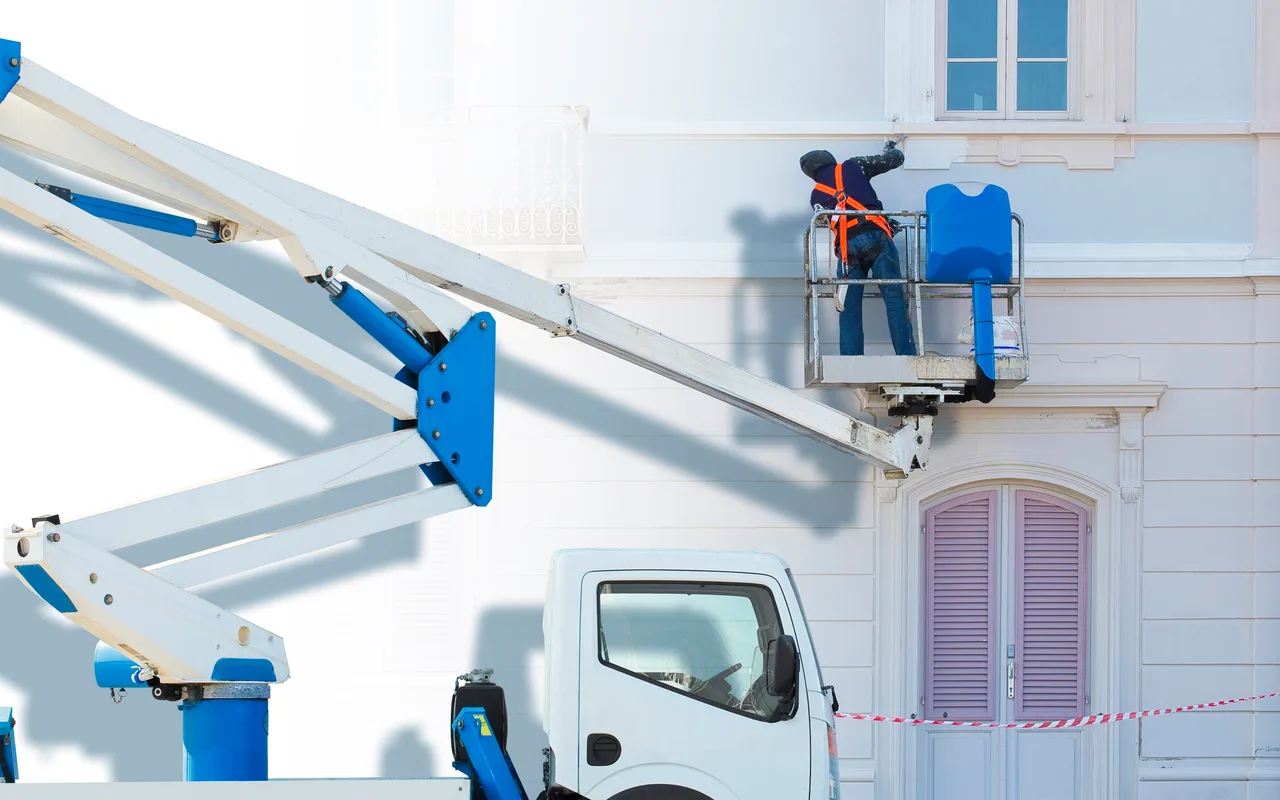
- Access costs are forgotten entirely. Scaffolding or a boom lift on a two-storey exterior doesn't show up on the quote - it shows up on the invoice from the supplier.
What a Production Rate Actually Is
A production rate is simply how many square metres (or square feet) a painter covers per hour on a specific surface under specific conditions. It's not a guess — it's a number derived from real-world painting tasks.
Here's how to think about it. Painting a standard interior wall — good conditions, one coat, minimal cutting in — might sit at around 15 m²/hr (150 ft²/hr). That's a baseline. A ceiling drops to 10 m²/hr (100 ft²/hr) because of the physical difficulty. Doors drop further to 6.5 m²/hr (70 ft²/hr) because of all the cutting in around frames, panels, and hardware. Heritage mouldings can fall as low as 3 m²/hr (30 ft²/hr).
Once you have your production rates, the maths is straightforward:
Surface area ÷ production rate = labour hours
A 50 m² (540 ft²) wall at 15 m²/hr takes 3.3 hours. At a fully-loaded labour cost of $35/hr USD (or $50/hr AUD), that's $116 USD or $165 AUD in labour — before paint, before margin. Now you're pricing from facts, not feel.
The Prep Level Nobody Uses (But Should)
Prep is applied as a percentage of your total surface hours. There are many levels, and the difference between choosing the wrong one is significant.
- None (0%): New surface or pre-prepped — no prep time added.
- Standard (30%): Light sand, spot fill, dust down.
- Moderate (50%): Full sand, fill and prime patches.
- Heavy (80%): Strip, scrape, extensive filling, full prime.
- Very Heavy (120%): Full paint removal, major substrate repair.
The most common quoting mistake is selecting Standard (30%) on a job that needs Heavy (50%) or Very Heavy (80%). That gap — 30% versus 50% — on a job with 20 hours of surface time islot of labour hours you didn't quote. That's $$$ walking straight out the door. On a larger exterior, it can be significant unquoted labour, every single job.
Before you finalise any exterior repaint quote, walk the surface with prep level in mind. If you're seeing peeling, chalking, bare substrate, rust, or previous patch repairs, you're looking at Heavy or Very Heavy — not Standard.
Don't Forget Downtime and Access
Two items that consistently get left out of quotes: area downtime and access equipment.
Area downtime — the time spent moving drop sheets, masking up, setting up equipment, and shifting between surfaces — is a real cost. A default of 10% applied to total surface hours is a reasonable allowance for most jobs. A 20-hour job has roughly 2 hours of downtime built in. That's not padding — that's reality.
Access equipment is more serious. A boom lift or EWP on a commercial repaint might cost $350–600/day USD to hire. Scaffolding on a two-storey residential exterior in many markets runs $1,500–3,000 USD for a standard house. If that cost isn't in your quote, it's coming out of your margin — or you're absorbing it and explaining to the client why the invoice is higher than expected.
Make access a line item in every quote where height work is involved. No exceptions.
Speed Steps: Adjusting for Real Conditions
Not every wall is a standard repaint in good conditions. Production rates should move based on the actual complexity of the job. A useful way to think about this is a stepped scale from intricate work to full production spray:
- Heritage mouldings and fine cutting in: 3 m²/hr (30 ft²/hr)
- Panels, multi-sided surfaces, lots of cutting in: 6.5 m²/hr (70 ft²/hr)
- Average complexity with some cutting in: 10 m²/hr (100 ft²/hr)
- Standard repaint, good conditions: 15 m²/hr (150 ft²/hr)
- Open areas, minimal cutting in: 20 m²/hr (200 ft²/hr)
- Large surfaces, good access: 25 m²/hr (250 ft²/hr)
- Production spray, repetitive surfaces: 30 m²/hr (300 ft²/hr)
When you're pricing a new-build with open stud walls and repetitive layout, spray is realistic. When you're quoting a Victorian terrace with original timber joinery, intricate is honest. Applying a standard rate to both jobs is how one of them loses money.
Surfacely's quoting system is built around these exact speed steps, so every surface gets the right rate — not a blended guess applied to the whole job. Youre not deciding on math, youre applying the type of effort to the surface
Build a System, Not a Spreadsheet
There's nothing wrong with starting in a spreadsheet. But spreadsheets don't enforce consistency. When your estimator quotes one way and your site foreman thinks about hours differently, you end up with quotes that don't reflect what jobs actually cost.
A good pricing system for painting jobs does three things: it applies fixed production rates to measured areas, it forces a deliberate prep level decision on every surface, and it captures all costs — including access — before the quote goes out.
That's not complicated. But it does require discipline, and it's much easier when the system builds those decisions into the quoting process itself rather than relying on whoever is doing the quote that day to remember them all.
The Bottom Line
Learning how to price a paint job accurately isn't about charging more. It's about charging for what the job actually costs. When you apply real production rates, honest prep levels, and account for every cost including access and downtime, you stop subsidising clients with your own labour.
Pick your next quote. Walk the job. Write down the surface areas. Assign a production rate and a prep level to each surface. Add access if it's needed. Then build your price from those numbers — not from what you think the client will pay, and not from what you quoted last time.
If you want a system that does this consistently across every job your business quotes, Surfacely is built exactly for that.