
Painting Business Profit Margins: Targets and How to Protect Them
Healthy painting businesses target 35–50% gross margin on labour, 20–30% on materials, 15% on access equipment hire, and 25% on overhead allocations. The blended gross margin on a typical residential repaint runs 38–45%. Painters who quote with markup (cost × 1.30) instead of margin (cost ÷ 0.70) leave $100 of revenue on every $1,000 of cost — about a quarter of what they thought they were earning.
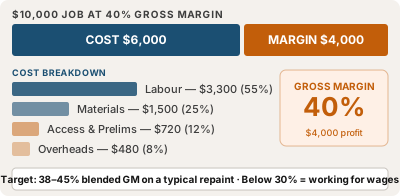
What margin should a painting business target?
Margin targets vary by cost category. Each category has different volume, risk, and overhead absorption — so a single blended target hides the real story.
| Cost category | Healthy gross margin target | Why it differs |
|---|---|---|
| Labour | 35–50% | Highest margin because of the on-cost stack the painter carries — super, workers' comp, leave, training, sick days. Margin recovers the productivity gap. |
| Materials | 20–30% | Lower because painters compete on visible material lines and clients can shop the same paint. Volume buying is the only real lever. |
| Access equipment hire | 15% | The painter's role is logistics, not value-add. Margin recovers the booking, delivery scheduling, and risk of cancellation. |
| Prelims (wash, masking, fittings removal) | 15% | Often labour-priced. Margin set lower because clients see "prep" as a commodity. |
| Overhead allocations (per-job) | 25% | Recovers the supervisor and admin time directly tied to the job. Fixed overheads like rent are recovered through labour margin. |
Surfacely's defaults: 45% labour, 30% material, 15% access, 15% prelims, 25% overheads. These are tuned for a residential repainter running 3–10 staff. Commercial work typically runs 5–10 percentage points lower across the board because of competitive tender pricing.
The markup vs margin confusion — quantified
The most expensive arithmetic mistake in the painting trade. Charging "cost plus 30%" produces a 23.1% margin, not 30%.
| Target margin | Correct cost-plus multiplier | Wrong (markup) multiplier | Revenue lost per $1,000 cost |
|---|---|---|---|
| 20% | ÷ 0.80 (× 1.250) | × 1.20 | $41.67 |
| 25% | ÷ 0.75 (× 1.333) | × 1.25 | $66.67 |
| 30% | ÷ 0.70 (× 1.429) | × 1.30 | $100.00 |
| 35% | ÷ 0.65 (× 1.538) | × 1.35 | $134.62 |
| 40% | ÷ 0.60 (× 1.667) | × 1.40 | $166.67 |
| 45% | ÷ 0.55 (× 1.818) | × 1.45 | $204.55 |
| 50% | ÷ 0.50 (× 2.000) | × 1.50 | $250.00 |
Gross margin vs net margin — where overheads disappear
Gross margin is per-job: sell minus direct cost (labour, materials, access equipment, prelims, per-job overhead). Net margin is annual: gross profit minus fixed overheads. The fixed overheads to subtract:
- Office or workshop rent
- Vehicle finance, insurance, fuel, registration (apportioned)
- Software subscriptions (accounting, scheduling, scoping, business email)
- Marketing — Google Ads, website hosting, lead-gen tools
- Professional services — accountant, insurance broker, legal advice
- Principal's drawings or salary (if not in direct labour cost)
- Admin staff time (if not in direct overhead)
- Bad debts and warranty repair allowance
A painting business running 40% gross typically nets 8–15% after fixed overheads. Below 30% gross, net margin is usually negative — the painter is being paid wages but the business itself is losing money.
Material margin — why it's lower than labour
Material is a transparent commodity. The client can google the price of a 10 L (2.6 gal) tin of any major-brand acrylic — Dulux, Resene, Sherwin-Williams, Benjamin Moore, Behr. The painter can't run 50% margin on materials because the client will check.
Where material margin actually comes from:
- Volume buying. A trade account at the right reseller drops cost 20–30% below retail. That gap becomes margin without raising the client's price.
- Buy-size rounding. Surfacely rounds material orders up to standard container sizes (1L, 4L, 10L, 15L, 20L for metric; quart, gallon, 5-gallon for imperial). The painter charges for the rounded buy quantity. The leftover paint sits in the workshop for the next touch-up.
- Coverage adjustment. Surfacely applies a coverage multiplier to spread rate when the substrate is rough (×0.70 — 30% less coverage) or sealed (×1.15 — better coverage). This protects the painter from underquoting on a porous substrate.
After-hours work — protecting margin on premium rates
The temptation when a job goes after-hours is to charge a flat extra fee. That's not margin-preserving. Surfacely scales both the cost and the sell by the same multiplier, so the margin percentage is preserved while the line total reflects the premium hours.
Take a 40-hour job where 30% of the work is done after-hours at a 1.5× rate. The cost goes up by 15%. The sell goes up by 15%. The margin percentage stays exactly where it was. The painter pays the crew the night rate, and the client pays for the hours done at night — without the painter having to do mental arithmetic to protect the margin.
The cost-plus model vs day-rate quoting
Day-rate quoting ("our crew is $1,200 a day, the job is 5 days, so it's $6,000") looks simple. It hides three problems:
- It can't price materials. Day rate doesn't scale with paint volume. A 2,150 ft² (200 m²) interior and a 2,150 ft² (200 m²) exterior need wildly different paint volumes — day-rate doesn't see this.
- It can't price prep. Heavy prep on heritage timber can more than double the labour of a standard repaint. Day-rate ignores this and the painter eats the gap.
- It hides margin. The painter doesn't know if the day rate includes a healthy margin or just barely covers cost. Surfacely's cost-plus model exposes the margin on every line, every quote.
Cost-plus pricing is harder to do by hand, which is why most painters default to day-rate or square-metre flat fees. A pricing system that runs the formula automatically is the only way to make cost-plus practical at quote-volume.
From the founder
I'm an estimator and a closer. Profit isn't a talent — it's a system, and running mine has generated millions in sales every year at an average gross profit of over 40%. Holding a number like that comes down to the details, and the single most expensive mistake I watched good painters make is the one on this page: quoting on markup instead of margin, and handing back a quarter of their profit without ever noticing it was gone.
That's why Surfacely never stores a sell price — it derives every one from your cost and your target margin, on every line. You can't accidentally mark up when the tool only ever divides down. Set the margin once, and it holds on every quote you send.
Related guides
FAQ
What is a good profit margin for a painting business?
35–50% gross on labour, 20–30% on materials, 15% on access, 25% on overheads. Blended gross 38–45% on residential repaint. Net 8–15% after fixed overheads.
What is the difference between gross margin and net margin for painters?
Gross is per-job. Net is annual after fixed overheads (rent, insurance, software, marketing, admin, principal's wages).
Why do painters confuse markup with margin?
Markup is added to cost. Margin is taken from sell. Cost × 1.30 produces a 23.1% margin, not 30%. The painter has to divide cost by 0.70 instead.
How do I protect my margin on material costs?
Volume buying drops cost. Buy-size rounding charges for the tin, not the litre. Cost-plus formula on material at 30% margin. Coverage adjustment for porous substrate.
Should I charge more for after-hours painting work?
Yes — multiply both cost and sell by the same factor (1.5× / 2× / 2.5×). Margin % stays put; line total goes up. Don't add a flat extra fee.
What overheads should I factor into a painting quote?
Direct overheads (per-job admin, supervision, vehicle for that job) on the quote. Fixed overheads (rent, insurance, marketing, principal's wages) recovered through gross margin across all jobs.