
How to Quote a Painting Job: The Complete Formula (2026)
A painting quote has four cost components: labour, materials, overheads, and the access and prep that sit alongside them. The pricing rule that turns those costs into a fair price is the cost-plus formula: sell price equals cost divided by (1 minus your target margin percent). This is not the same as adding a markup percentage — and confusing the two is the single most common pricing mistake in the painting trade. It costs painters real money on every job.
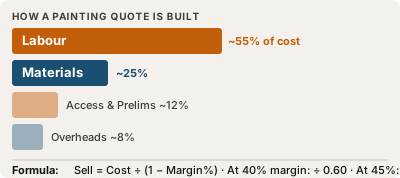
The cost-plus formula
The pricing rule sounds technical but it's plain arithmetic:
If your costs on a job add up to $4,000 and you want a 40% margin, you charge $4,000 ÷ 0.60 = $6,667. The resulting margin is exactly 40% of what you charged. Sell minus cost equals $2,667, which is 40% of $6,667.
Markup vs margin — what each multiplier actually delivers
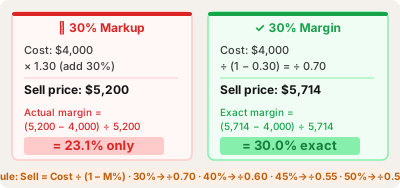
The table below makes the gap explicit. The "wrong multiplier" column is what painters reach for when they think markup means margin. The right column is what the cost-plus formula actually produces. The final column shows the revenue lost on every $1,000 of cost when the wrong multiplier is used.
| Target margin | Correct cost-plus multiplier | Wrong (markup) multiplier | Revenue lost per $1,000 cost |
|---|---|---|---|
| 20% | ÷ 0.80 (× 1.250) | × 1.20 | $41.67 |
| 25% | ÷ 0.75 (× 1.333) | × 1.25 | $66.67 |
| 30% | ÷ 0.70 (× 1.429) | × 1.30 | $100.00 |
| 35% | ÷ 0.65 (× 1.538) | × 1.35 | $134.62 |
| 40% | ÷ 0.60 (× 1.667) | × 1.40 | $166.67 |
| 45% | ÷ 0.55 (× 1.818) | × 1.45 | $204.55 |
| 50% | ÷ 0.50 (× 2.000) | × 1.50 | $250.00 |
Read it like this: a painting business doing $500,000 of cost a year and quoting at 30% markup instead of 30% margin is leaving $50,000 on the table over the year. That's not rounding error — that's a tradesperson's wage.
Labour cost — the biggest line on most quotes
Labour cost is the painter's time on the job multiplied by your loaded cost rate. Loaded cost rate is what a painter actually costs your business per productive hour — wages plus statutory on-costs (super or pension, payroll tax, workers' comp), plus paid leave, plus allowances. The free Labour Cost Calculator builds it from your locale's actual numbers.
Labour sell = Total hours × (Cost rate ÷ (1 − Labour margin%))
Total hours come from the surface measurement. For each surface, hours equal the painted area times the number of coats divided by the production rate (ft²/hr in imperial markets, m²/hr in metric markets), plus prep hours from the surface area and its own prep rate. The painting production rates reference walks through the 8-step speed scale Surfacely uses, from intricate heritage cutting-in at the slow end up to production spray on new builds at the fast end.
After-hours work
When part of the job runs outside normal hours — a retail repaint at night, a school over the holidays — the painter pays the crew a higher rate, so the client should pay a higher rate too. Surfacely splits labour into a normal portion and an after-hours portion at a multiplier you choose (typically 1.5× evening, 2× weekend, 2.5× public holiday). Both cost and sell scale by the same factor, which means your margin percentage is preserved automatically — no margin leak hiding in the after-hours line.
Material cost — the line clients can shop online
Material cost is the volume of paint you'll use multiplied by your cost per container. Paint volume comes from the area painted times the coat count divided by the paint's spread rate.
Material cost = Buy volume × Your cost per container
Spread rate varies by paint type, sheen, and how porous the substrate is. A premium interior acrylic on a sealed plasterboard wall covers significantly more area per litre than the same acrylic on a rough render. The table below shows typical ranges for common paint types in both metric and imperial.
| Paint type | Typical spread (ft²/gal) | Typical spread (m²/L) | Spray adjustment |
|---|---|---|---|
| Interior acrylic / latex / emulsion | 570 – 650 | 14 – 16 | +25% material |
| Interior enamel / gloss | 570 – 650 | 14 – 16 | +25% material |
| Exterior masonry / weather coating | 490 – 570 | 12 – 14 | +25% material |
| Roof coating | 240 – 410 | 6 – 10 | +25% material |
| Epoxy floor | 240 – 325 | 6 – 8 | Spray rare; brush/roll typical |
| Primer / sealer | 410 – 570 | 10 – 14 | +25% material |
| Texture coat / render | 80 – 165 | 2 – 4 | Sprayed almost exclusively |
Round the calculated paint volume up to a buy size before multiplying by cost. You don't pay for half a tin. Common metric sizes are 1L, 2L, 4L, 10L, 15L, and 20L. Common imperial sizes are 1 quart, 1 gallon, and 5 gallons. Surfacely rounds automatically and shows the painter both the measured need and the buy quantity.
Worked example — a 3-bedroom interior repaint
Two coats of acrylic on the walls and ceilings, three coats of enamel on the doors, two coats on the windows. Standard prep — wash, light sand and dust down (25 m²/hr, or 270 ft²/hr). The example below uses an Australian crew at AUD $50/hr loaded cost; substitute your own currency and rate to apply it locally.
| Surface | Area (or quantity) | Coats | Hours | Paint volume |
|---|---|---|---|---|
| Walls | 2,150 ft² (200 m²) | 2 | 26.7 | 33L (≈ 9 gal) — buy 4 × 10L tins |
| Ceilings | 860 ft² (80 m²) | 2 | 16.0 | 13L (≈ 3.5 gal) — buy 2 × 10L tins |
| Doors | 10 (about 200 ft² or 19 m²) | 3 | 8.7 | 5L (≈ 1.3 gal) — buy 1 × 10L tin |
| Windows | 12 (about 195 ft² or 18 m²) | 2 | 5.5 | 3L (≈ 0.8 gal) — buy 1 × 4L tin |
| Subtotal | — | — | 56.9 | — |
| Standard prep (30%) | — | — | +17.1 | — |
| Total hours | — | — | 74.0 | — |
Now stack the costs. Margins shown are the Surfacely defaults — your business may target different numbers per category.
| Cost line | Calculation | Cost | Margin | Sell |
|---|---|---|---|---|
| Labour | 74.0 hr × $50/hr | $3,700 | 45% | $6,727 |
| Materials (acrylic) | 50L × $13/L (rounded buy) | $650 | 30% | $929 |
| Materials (enamel) | 14L × $15/L | $210 | 30% | $300 |
| Overheads (per-job allocation) | fixed | $200 | 25% | $267 |
| Subtotal (excl. tax) | — | $4,760 | — | $8,223 |
| GST (10% AU example) | — | — | — | $822 |
| Total (incl. tax) | — | — | — | $9,045 |
Gross profit on this quote: $8,223 − $4,760 = $3,463. Gross margin: 42.1%. That's the blended margin a healthy painting business should be running for residential repaint work.
Repaint vs new build — different numbers, same formula
Surfacely treats project type as a permanent flag on the project — repaint or new build, set once at creation. The differences in pricing logic matter:
- Wash and preparation. New builds skip the external pressure-wash line — bare substrate doesn't need washing. Repaints get a wash line generated automatically based on the external area.
- Default coats. New builds typically need primer plus 2 topcoats (3 coats total). Repaints are 2 coats unless specified.
- Prep level. New builds default to "Standard" (25 m²/hr, or 270 ft²/hr). Repaints often need "Moderate" (16, or 170) or "Heavy" (10.5, or 115) on doors and trim — the slower the rate, the more prep.
- Production rate. Open new-build walls and ceilings often qualify for fast spray rates. A repaint of a furnished, occupied home rarely beats the standard step.
Same cost-plus formula, different inputs. The formula is the constant; the rest is the painter's judgement.
Related guides
- Painting production rates: complete reference
- How to measure surfaces for painting
- Painting business profit margins
- Painting labour rates by region
FAQ
What is the formula for quoting a painting job?
Sell price equals total cost divided by (1 minus your target margin percent). Total cost is labour plus materials plus access plus prep plus overheads. Apply the formula category by category to protect each margin separately.
What is the difference between markup and margin in painting?
Markup is added to cost. Margin is taken from sell. Cost times 1.30 is a 30% markup but only a 23.1% margin. To actually earn 30% you divide cost by 0.70. The wrong formula leaves $100 on every $1,000 of cost.
How much should I charge per hour as a painter?
Sell rate equals loaded cost rate divided by (1 minus your target margin percent). At a $50/hr loaded cost and 45% margin, the sell rate is about $90.91/hr. The right loaded cost rate is local — AU $42–$60, US $30–$55, UK £18–£30, NZ $32–$46, CA $30–$45 are typical 2026 ranges.
How do I calculate material costs for a painting quote?
Paint volume equals area times coats divided by spread rate. Round up to the next container size. Multiply by your cost per litre or per gallon. Apply cost-plus at your material margin (typically 30%).
What margin should a painting business aim for?
35–50% on labour, 20–30% on materials, around 15% on access hire, 25% on overheads. Surfacely defaults to 45% labour and 30% material — blended gross around 40% on a typical residential repaint.
How do I quote exterior painting differently from interior?
Add a pressure wash line (the area divided by your wash rate), book access equipment as its own cost line, and bump the prep level for sun damage and biological growth. Paint also covers less per litre on rough exterior substrates.
Should I charge GST or VAT on a painting quote?
Yes if your business is registered. AU 10% GST when turnover is above AUD $75,000. NZ 15% GST. UK 20% VAT. CA varies by province. US services usually aren't subject to sales tax — check your state. Surfacely handles all of these automatically based on the painter's country.
How do I handle variations to a painting quote?
Once accepted, the quote is locked. Additional work is raised as a numbered Variation (Addition or Reduction) and approved by the client through the portal. Never edit the accepted quote — you lose the audit trail.