
How to Measure Surfaces for Painting: Formulas for Every Surface Type
Painting measurement is not a single formula. Each surface type — walls, ceilings, doors, windows, fascia, gutters, roofs, balustrades — has its own area formula that reflects how the painter actually applies coating to it. Get the formula right, and the litres and hours fall out automatically. Get it wrong, and you under- or over-quote by 20%.
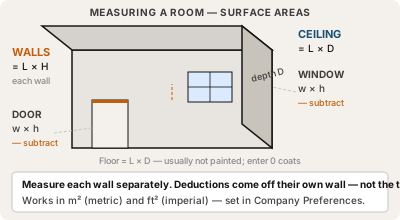
Reference table — formulas for all 24 surface types
The Surfacely surface library covers 24 painting surface types plus a Custom catch-all. Each is mapped to a specific area formula, default coat count, and default speed step. The formula determines what fields the painter measures during scoping.
| Surface | Unit | Formula | Default coats | Default prep |
|---|---|---|---|---|
| Walls | ft² (m²) | length × height × qty | 2 | Standard 30% |
| Ceilings | ft² (m²) | length × width × qty | 2 | Standard 30% |
| Floors | ft² (m²) | length × width × qty | 2 | Moderate 50% |
| Roofs | ft² (m²) | plan area × pitch factor | 2 | Standard 30% |
| Doors | ft² (m²) | face × qty (Both Sides toggle) | 3 | Heavy 80% |
| Windows | ft² (m²) | frame perimeter + sill + reveal + architrave | 2 | Moderate 50% |
| Skirting | lf (lineal m) | length × board height | 2 | Standard 30% |
| Stairs | ft² (m²) | treads + landing + stringers | 2 | Standard 30% |
| Gutter | lf (lineal m) | length × profile girth | 2 | Standard 30% |
| Fascia | lf (lineal m) | length × board width | 2 | Standard 30% |
| Soffit | ft² (m²) | length × overhang depth | 2 | Standard 30% |
| Barge board | lf (lineal m) | length along the slope × board width | 2 | Standard 30% |
| Rafter tails | ft² (m²) | girth × length × qty | 2 | Standard 30% |
| Gable end | ft² (m²) | base × height ÷ 2 (triangle) | 2 | Standard 30% |
| Posts | lf (lineal m) | girth × height × qty | 2 | Standard 30% |
| Downpipes | lf (lineal m) | pipe girth × length × qty | 2 | Standard 30% |
| Slab edge | lf (lineal m) | length × edge height | 2 | Standard 30% |
| Balustrades & handrails | ft² (m²) | length × height × girth multiplier | 2 | Standard 30% |
| Steel beam | ft² (m²) | girth × length × qty | 2 | Moderate 50% |
| Timber beam | ft² (m²) | girth × length × qty | 2 | Standard 30% |
| Timber deck | ft² (m²) | length × width × qty | 2 | Moderate 50% |
| Brickwork | ft² (m²) | length × height × qty | 2 | Standard 30% |
| Exposed ceiling | ft² (m²) | length × width × qty | 2 | Moderate 50% |
| Metal cladding | ft² (m²) | length × height × qty | 2 | Light 20% |
Doors — components, not just faces
A painted door is rarely just a face. The Surfacely door surface uses a component system so the painter can include only what's actually painted:
- Face. Door width × door height. Toggle "Both sides" to multiply by 2.
- Frame. The visible architrave and head jamb. Calculated from face width default 2 in (50 mm).
- Jamb. The internal sides of the opening. Default 3.5 in (90 mm) deep.
- Architrave. The trim moulding around the frame. Default 2.75 in (70 mm) profile.
A standard 32 × 80 in internal door (820 × 2040 mm) painted both sides with frame and architrave totals about 59 ft² (5.5 m²) of paintable surface — not the 18 ft² (1.7 m²) that face × 2 would suggest.
Windows — frame, sill, reveal, architrave (no glass)
Painters don't paint glass. The Surfacely window surface measures only the framed elements:
- Frame perimeter. The painted timber/aluminium around the window opening.
- Sill. The horizontal ledge at the bottom — depth × width.
- Reveal. The internal sides of the opening — typically 3.5 in (90 mm).
- Architrave. The trim moulding on the wall around the frame.
For a typical 48 × 60 in double-hung window (1200 × 1500 mm), paintable area is roughly 16 ft² (1.5 m²) — not the 19 ft² (1.8 m²) that gross dimensions suggest.
Balustrades — the girth multiplier
A balustrade or handrail is mostly air. The actual painted material is the top rail, balusters, and bottom rail — typically about 30% of the bounding rectangle. By default Surfacely calculates the paintable area as length × height × 0.3, with the 0.3 multiplier adjustable for high-density work (wrought iron with decorative scrollwork) or low-density (modern wire balustrade) systems.
Stairs — treads, risers, landings, stringers
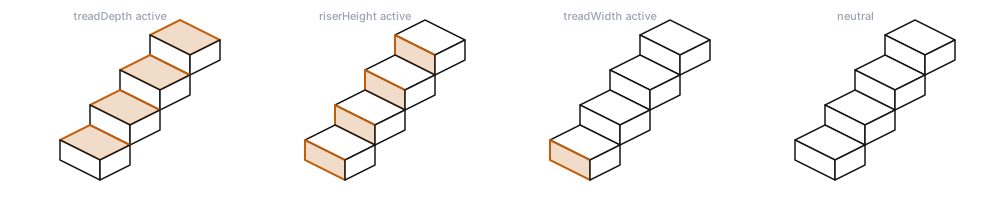
A staircase is four stacked surfaces. Surfacely captures each:
- Treads. Number of steps × tread depth × staircase width.
- Risers. Number of steps × riser height × staircase width.
- Landing. Optional — landing length × landing width.
- Stringers. The diagonal sides — measured as girth × length, typically two per flight.
Roofs — plan area times pitch factor
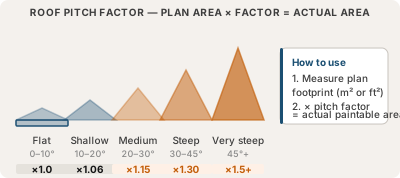
Don't measure a roof from a ladder unless you have to. The fast and accurate method is to take the building footprint (length × width × number of sections) from a measuring app or aerial photo, then multiply by a pitch factor that accounts for the slope. The Surfacely roof formula is:
| Roof character | Pitch factor | Approximate slope angle |
|---|---|---|
| Flat | 1.00 | 0–5° |
| Shallow | 1.05 | 5–15° |
| Standard | 1.15 | 15–25° |
| Steep | 1.25 | 25–35° |
| Very steep | 1.35 | 35–45° |
| Extreme | 1.50 | 45°+ |
Metric vs imperial — what each region uses
| Country | Length | Area | Volume | Spread rate | Production rate |
|---|---|---|---|---|---|
| Australia | m / mm | m² | L | m²/L | m²/hr |
| United States | ft / in | ft² | gal | ft²/gal | ft²/hr |
| United Kingdom | m / mm | m² | L | m²/L | m²/hr |
| New Zealand | m / mm | m² | L | m²/L | m²/hr |
| Canada | ft / in (most) or m | ft² or m² | gal or L | ft²/gal or m²/L | ft²/hr or m²/hr |
Surfacely stores all measurements in metric and converts to the painter's locale at the display layer. There's no precision loss — 1 m² is exactly 10.7639 ft², and the same numbers are returned every time.
Paintable area vs gross area — what to deduct
The single biggest measurement error is over-deducting openings. The rules:
- Don't deduct openings under 10 ft² (1 m²). The cutting-in time around a small window or power point recovers the missing area.
- Do deduct large openings — over 50 ft² (5 m²). A garage door or feature window is a real area that won't be painted.
- Between 1 and 5 m²: deduct half. Or use Surfacely's quantity stepper to record the openings as separate surfaces (which is more accurate anyway).
Related guides
FAQ
How do I measure walls for painting?
Wall area = length × height × quantity. Length is the run of one wall face; height is floor to ceiling, excluding skirting. Don't deduct openings under 10 ft² (1 m²).
Do I measure windows and doors and deduct them?
Don't deduct. Measure them as their own line items. The cutting-in time around small openings recovers the painted area, and capturing them separately gives accurate coat counts (doors are 3 coats; walls are 2).
How do I measure a roof for painting?
Plan area × pitch factor. Plan area is the building footprint. Pitch factor: flat 1.0, shallow 1.05, standard 1.15, steep 1.25, very steep 1.35, extreme 1.50.
What is a girth measurement in painting?
The total wrapped perimeter of a linear element. For a 3.5 × 3.5 in (90 × 90 mm) post, girth = 14 in (360 mm). For a 4 in (100 mm) round downpipe, girth = π × 100 ≈ 12.4 in (314 mm). Girth × length = paintable surface area.
How do I measure fascia and soffit for painting?
Fascia: linear run × board width (typically 6 in / 150 mm). Soffit: run length × overhang depth.
How do I calculate the area of a balustrade for painting?
Length × height × girth multiplier. The default multiplier is 0.3 — accounting for the gaps between balusters. A 16 × 3 ft (5 m × 1 m) balustrade has roughly 16 ft² (1.5 m²) of paintable material.
What is paintable area vs gross area?
Gross area is the bounding rectangle. Paintable area is the actual material to be painted. They're the same for solid surfaces; very different for balustrades and windows.