
Painting Production Rates: Complete Reference Guide (2026)
Painting production rates range from 32 ft²/hr (3 m²/hr) for intricate heritage detail to 375 ft²/hr (35 m²/hr) for production spray on new builds. The correct rate for the job type is the single biggest driver of quote accuracy — pick it wrong and the rest of the math is decorative.
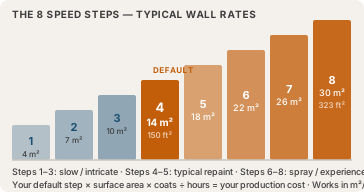
The 8 speed steps
Surfacely uses 8 speed steps. The same step number always returns the same rate within a painting business, regardless of which surface is being painted — what changes is the default step assigned to each surface.
| Step | Character | ft²/hr | m²/hr | When to use |
|---|---|---|---|---|
| 1 | Intricate | 32 | 3 | Heritage mouldings, fine cutting in, decorative stencil work |
| 2 | Detailed | 70 | 6.5 | Panels, multi-sided components, lots of cutting in |
| 3 | Careful | 110 | 10 | Some cutting in, average complexity, overhead work |
| 4 | Steady | 160 | 15 | Standard repaint in good condition — the system default |
| 5 | Efficient | 215 | 20 | Open areas with minimal cutting in |
| 6 | Open | 270 | 25 | Large surfaces with good access |
| 7 | Spray | 325 | 30 | Production spray, repetitive surfaces |
| 8 | New-build spray | 375 | 35 | Full new-build spray, maximum coverage |
The table above lists ft²/hr first with the exact m²/hr figure alongside — metric remains the stored default behind the scenes. Painters in the US and parts of Canada work directly in ft²/hr; each imperial default is the clean ft²/hr nearest the true conversion (32 ft²/hr = 2.973 m²/hr, etc.).
Production rate by surface type
Rates shown at Step 4 (default). Adjust for your painters' experience using the 8-step scale above.
Each surface starts at a default speed step. The painter overrides during measurement when the conditions warrant it. Default coats and area formula are also shown — these match the Surfacely surface library.
| Surface | Default step | ft²/hr | m²/hr | Coats | Area formula |
|---|---|---|---|---|---|
| Walls | 4 — Steady | 160 | 15 | 2 | length × height × qty |
| Ceilings | 3 — Careful | 110 | 10 | 2 | length × width × qty |
| Floors | 4 — Steady | 160 | 15 | 2 | length × width × qty |
| Roofs | 5 — Efficient | 215 | 20 | 2 | plan area × pitch factor (1.0 – 1.5) |
| Doors | 2 — Detailed | 70 | 6.5 | 3 | door face × qty (Both Sides toggle) |
| Windows | 2 — Detailed | 70 | 6.5 | 2 | frame perimeter + sill + reveal + architrave (no glass) |
| Balustrades & handrails | 2 — Detailed | 70 | 6.5 | 2 | length × height × qty |
| Stairs | 3 — Careful | 110 | 10 | 2 | treads + landing + stringers |
| Gutter | 4 — Steady | 160 | 15 | 2 | linear metres × profile girth |
| Fascia | 4 — Steady | 160 | 15 | 2 | linear metres × board width |
| Barge board | 3 — Careful | 110 | 10 | 2 | linear metres × board width (along the slope) |
| Rafter tails | 2 — Detailed | 70 | 6.5 | 2 | girth × length × qty |
| Gable end | 4 — Steady | 160 | 15 | 2 | base × height ÷ 2 (triangle) |
| Posts | 2 — Detailed | 70 | 6.5 | 2 | girth × height × qty |
| Downpipes | 3 — Careful | 110 | 10 | 2 | pipe girth × length × qty |
| Skirting | 2 — Detailed | 70 | 6.5 | 2 | linear metres × board height |
| Slab edge | 3 — Careful | 110 | 10 | 2 | linear metres × edge height |
| Soffit | 3 — Careful | 110 | 10 | 2 | length × width × qty |
| Steel beam | 2 — Detailed | 70 | 6.5 | 2 | girth × length × qty |
| Timber beam | 2 — Detailed | 70 | 6.5 | 2 | girth × length × qty |
| Timber deck | 3 — Careful | 110 | 10 | 2 | length × width × qty |
| Brickwork | 3 — Careful | 110 | 10 | 2 | length × height × qty |
| Exposed ceiling | 2 — Detailed | 70 | 6.5 | 2 | length × width × qty |
| Metal cladding | 4 — Steady | 160 | 15 | 2 | length × height × qty |
Prep level — a production rate of its own
Prep has its own production rate, in the same units as your painting rates: how much surface you prep in an hour. A slower rate means more prep. Surfacely uses 11 prep levels — 8 cover everyday repaints, 3 cover restoration extremes. Prep is charged once, before the first coat, so the coat count never changes it. It depends on the condition of the surface and nothing else: spraying a wall doesn't sand it, so how fast you paint never changes the prep.
| Level | Prep rate | When to apply |
|---|---|---|
| None | — | Paint-ready — new or pre-prepped |
| Minimal | 75 m²/hr (800 ft²/hr) | Near new — wash and light dust, the odd spot fill |
| Light | 52.5 m²/hr (565 ft²/hr) | Sound paint — light sand and dust down, minimal filling |
| Sound | 35 m²/hr (375 ft²/hr) | Sound surface — sand and spot fill |
| Standard | 25 m²/hr (270 ft²/hr) | Typical repaint — wash, sand, fill, spot prime |
| Moderate | 16 m²/hr (170 ft²/hr) | Older surface — more filling, minor repairs, some scraping |
| Heavy | 10.5 m²/hr (115 ft²/hr) | Neglected or peeling — widespread scraping and filling, primer spots |
| Very heavy | 6.5 m²/hr (70 ft²/hr) | Flaking throughout — scrape back, fill, full prime |
| Extensive | 4 m²/hr (43 ft²/hr) | Major repair — strip failed areas back to substrate |
| Strip Back | 2.5 m²/hr (27 ft²/hr) | Strip the whole surface back |
| Strip & Rebuild | 1.5 m²/hr (16 ft²/hr) | Strip and rebuild the substrate |
| Restoration | 1 m²/hr (11 ft²/hr) | Full heritage restoration — prep dominates the job |
Application method effect
Method affects both speed and material consumption. Spray uses about 25% more paint than brush and roll, but accelerates speed step on broad surfaces. Moderate prep auto-applies when spray is selected on an existing-paint substrate.
| Method | Material use | Speed | Auto-applied |
|---|---|---|---|
| Brush / roll | Base spread rate | Surface default step | — |
| Spray | +25% over base | Step 6 (Open) or higher on broad surfaces | Moderate prep on existing substrate |
How production rates drive your quote
Once the rate, area, coats and prep are known, the job hours fall out cleanly. For each surface: paint hours = area × coats ÷ production rate. Then add the prep hours — area ÷ prep rate — on top to get the total hours for that surface. There is no coats term in the prep half: you prep once, before the first coat. Sum across every surface in the scope and that's the total labour time for the job.
From there, multiply total hours by your loaded labour cost rate to get the labour cost. Apply the cost-plus formula — sell price = cost ÷ (1 − margin%) — to derive the sell price at your target margin. Surfacely runs all of this automatically on every quote so the painter doesn't have to do it by hand on a calculator.
If a surface is sprayed instead of brushed, the production rate steps up (typically to Step 6 or higher) and the paint volume goes up by about 25% to account for overspray. The cost-plus formula doesn't change.
Regional rate differences
Production rates are the same physical activity wherever you are — what changes is the unit. Surfacely stores everything in m²/hr internally and converts to ft²/hr at the display layer for US painters and parts of Canada. The exact stored values for imperial defaults are:
| Speed step | Imperial display | Stored metric (m²/hr) |
|---|---|---|
| 1 — Intricate | 32 ft²/hr | 2.973 |
| 2 — Detailed | 70 ft²/hr | 6.503 |
| 3 — Careful | 110 ft²/hr | 10.218 |
| 4 — Steady | 160 ft²/hr | 14.865 |
| 5 — Efficient | 215 ft²/hr | 19.974 |
| 6 — Open | 270 ft²/hr | 25.084 |
| 7 — Spray | 325 ft²/hr | 30.194 |
| 8 — New-build spray | 375 ft²/hr | 34.839 |
Spray vs brush and roll — when spray is not faster
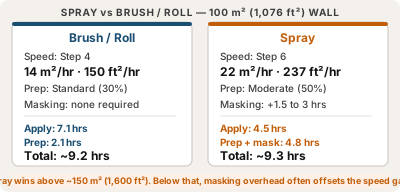
Spray wins on broad, uninterrupted surfaces with clear access. It loses time in three places that aren't always obvious:
- Masking. Every fixture, window, edge, and adjacent surface needs taping and sheeting. On a confined room, masking takes longer than the spray pass itself.
- Overspray containment. Drop sheets, plastic walls, exclusion zones — Surfacely flags these automatically on any job where you're spraying.
- Material waste. Spray uses 25% more product. On an expensive coating like roof membrane or epoxy floor, this often wipes out the labour saving.
The decision rule: if the surface is bigger than 300 ft² (30 m²), unobstructed, and the substrate is the same throughout — spray wins. Otherwise, brush and roll is faster all-in.
FAQ
What is a good production rate for painting walls?
For a standard wall repaint with average prep, the working rate is 160 ft²/hr (about 15 m²/hr) — Speed Step 4 'Steady'. Open new-build walls can run at 20–25 m²/hr by brush and roller, and 30–35 m²/hr by spray. Heritage cutting-in or panelled work drops to 6.5 m²/hr (Speed Step 2 'Detailed') or lower.
How do I calculate how long a painting job will take?
Hours = (paintable area × number of coats) ÷ production rate, then add prep hours of area ÷ prep rate. Standard prep runs 25 m²/hr (270 ft²/hr), moderate 16 (170), heavy 10.5 (115) — a slower rate means more prep, and prep is charged once, not per coat. Sum the result for every surface to get the total job hours.
Why does spray painting not always mean faster production?
Spray is fastest on broad, uninterrupted surfaces with clear access — exteriors of new builds, warehouse walls, ceilings in empty rooms. In confined or detailed spaces, the masking and overspray containment time consumes the speed advantage. Spray also uses about 25% more material than brush and roll. For a small bedroom with skirting, doors and trim, brush and roll often beats spray.
What production rate should I use for ceiling painting?
Ceilings default to Speed Step 3 ('Careful') — about 110 ft²/hr (10 m²/hr) — because of overhead arm fatigue and the cutting in around cornices and light fittings. Open warehouse ceilings sprayed from a scaffold can run at Speed Step 6–8 (25–35 m²/hr).
How does prep time affect a painting quote?
Prep has its own production rate in m²/hr, charged once before the first coat — it is not a percentage of paint hours, and the coat count never changes it. Standard (wash, sand, fill, spot prime) is 25 m²/hr, the baseline for a sound repaint; surfaces in excellent condition may need only Minimal (75 m²/hr), Light (52.5) or Sound (35). Moderate is 16. Heavy is 10.5, where prep approaches paint time. Very heavy is 6.5, and major repair through to full heritage restoration runs 4 down to 1 — i.e. prep takes several times as long as painting.
What is the difference between m²/hr and ft²/hr?
1 square metre equals 10.7639 square feet. 15 m²/hr is therefore approximately 161 ft²/hr. Surfacely stores all rates in metric and converts to imperial only at the display layer for US painters.
How do I choose the right production rate for my quote?
Start from the surface's default speed step. Adjust up if access is open and the substrate is in good condition. Adjust down for cutting-in, intricate detail, heritage work, or first-coat work on bare substrate.
What production rate should I use for heritage or detailed work?
Heritage and intricate detail run at Speed Step 1 — 32 ft²/hr (3 m²/hr) by brush. This covers cornice work, panelled doors, multi-section windows, and decorative mouldings. Quoting heritage at standard rates is the single most common cause of underquoting on restoration jobs.