
Minimum Charge for a Painting Job: The Math Every Painter Needs to See
Every painter has stood in front of a small job and done the math in their head — and gotten it wrong. A "two-hour touch-up" sounds simple until you factor in drive time, setup, masking, cleanup, and the half-used tinted can sitting in your van that nobody else will ever buy. By the time you've actually accounted for what that job costs you, two hours became four — and you quoted for two. That gap is where small jobs quietly bleed you out.

Why Small Jobs Cost More Than They Look
The sticker price of labour is the easy part. What kills you on small jobs is everything that happens before the brush touches the wall and after the last coat dries.
Walk through a realistic scenario: a client wants a single feature wall repainted. The area is maybe 120 ft² (11 m²). At a standard production rate for walls — 160 ft²/hr (15 m²/hr) across two coats — that's about 1.5 hours of brush time. Add 10% area downtime for masking and setup, and you're at 1.7 hours. Sounds fine.
Now add the real costs:
- Travel: 30 minutes each way is an hour of paid windshield time, before you've lifted a brush.
- Setup and cleanup: Drop sheets, tape, moving furniture, cleaning brushes and rollers — another 30 to 45 minutes minimum.
- Tinted paint: The client wanted a custom colour. You bought a gallon (3.8 litres). You used maybe a third of it. The rest can't go back on the shelf. That paint cost is dead money on this job.
- Mobilisation overhead: Your vehicle, your fuel, your time coordinating the booking, your invoice admin.
Add it up honestly and that 1.5-hour paint job is a 3.5 to 4-hour cost event. If you quoted 1.5 hours of labour plus a partial can of paint, you handed back roughly half the job's true cost as a discount the client never even knew they got.
The Three Rules That Protect You Automatically
You can't renegotiate every small job in your head every time one comes in. That's exhausting and inconsistent — different painters on your team will handle it differently, and some will quote it at a loss without realising. The fix is setting three hard rules once and applying them to every quote.
1. Minimum Billable Hours Floor
Set a number below which no job gets quoted. Three hours is a reasonable floor for a single painter attending site — it covers mobilisation and leaves room for actual productive work. Four hours is defensible on any job requiring travel over 20 minutes.
This is not about squeezing clients. It's about recognising that showing up has a fixed cost regardless of how small the work is. A floor of three hours at a fully-loaded labour cost of $35/hr (USD) means your minimum labour recovery is $105 before materials. That's the real cost of attendance — not profit, just cost.
2. Minimum Paint Charge
Never price a job below the cost of a full can. If the surface only needs half a gallon (1.9 litres), charge for a full one. Custom tints are non-returnable. Partial cans have no resale value. The coverage math is straightforward — at a default spread rate of 489 ft²/gal (12 m²/L) per coat, a single gallon covers 489 ft² (45 m²) in one coat. Anything below that area still costs you a full can if the colour is tinted to order.
A minimum paint charge on every quote removes the guesswork and stops the habit of mentally rounding paint costs down because "it's only a small job."
3. Half-Day Round-Up
This one trips up a lot of contractors. Say a job genuinely takes 2.5 hours on site. If it's scheduled mid-morning, it blocks the crew from taking another job until after lunch. That half-day slot is gone. Quote it as a half-day.
Rounding up to the half-day isn't padding — it's accurate. A 2.5-hour job that parks a painter from 9am to noon costs you a full morning of that person's capacity. If you only charge 2.5 hours, the other 30 minutes (or more realistically, the travel and transition time around it) comes straight off your margin.
Yes, You'll Lose Some Small Jobs. That's the Point.
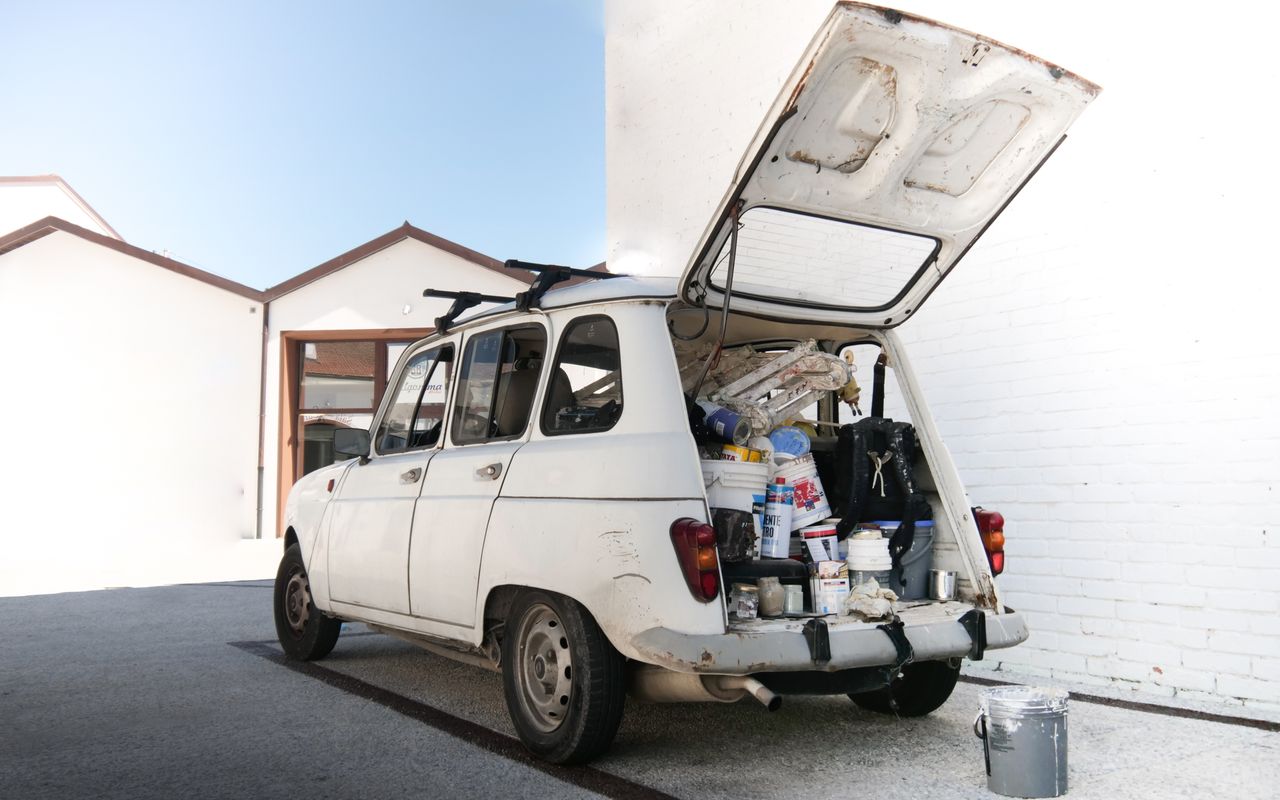
When you set a minimum charge for a painting job, some prospects will balk. A client wanting a single door repainted will call someone else when your minimum comes in at three hours. Let them.
The math is straightforward: a job that costs you four hours of real time and you charge two hours for is a job that costs you money to take. Turning that job away isn't losing revenue — it's protecting the afternoon slot for work that actually pays.
Contractors who resist minimums usually have one of two beliefs: that every job is a relationship worth keeping at any price, or that turning away work signals weakness. Neither holds up. Clients who only call when the work is tiny and balk at a fair minimum are not your target clients. Your target client values your time because they understand that skilled tradespeople have fixed costs. The minimum charge filters for exactly that.
There's also a positioning effect. A clear minimum signals that your business is organised and professional. Clients who've been burned by cheap, disorganised operators often see a minimum charge as a green flag, not a red one.
Set It Once, Apply It Everywhere
The problem with minimum charges isn't deciding what they should be — it's remembering to apply them consistently across every quote your team produces. One painter remembers, another doesn't. You quote a Saturday job and forget the minimum applies there too. A small job slips through at cost because nobody caught it.
Surfacely lets you set these three rules — minimum billable hours, minimum paint charge, and half-day round-up — directly on your rate card, so they apply automatically to every quote that comes out of your business. When a legitimate exception comes up and you genuinely want to make one, you override it on that quote with a note. The default is protection; the exception is deliberate.
That's the difference between a policy you intend to follow and one that actually runs in the background while you focus on the work.
Know Your Floor Before the Next Small Job Calls
The minimum charge for a painting job isn't an arbitrary number — it's the true cost of mobilisation, materials, and blocked capacity, priced honestly. Three hours of labour plus a full can of paint is a reasonable starting point for most markets. Adjust it for your travel radius, your crew costs, and the average paint price in your area.
Set the number. Build it into your quoting process. Apply it automatically. And stop discounting the cost of showing up.
If you want to see exactly what your minimum should be based on your actual labour costs and paint prices, run the numbers in Surfacely's quoting cost calculator.