
Prep Time Painting Estimate: Why Exterior Repaints Almost Always Run Over
Last month I reviewed the numbers on 12 exterior repaints. Every single one had prep time underestimated by at least 20%. Not one job came in at the prep allowance that was quoted. The contractor was covering the gap with production hours, eating into paint budget, or just quietly absorbing it. If that sounds familiar, the problem isn't your crew — it's the number you're putting on prep in the first place.
The 10% Habit That's Costing You on Every Repaint
Most painting contractors default to Standard prep on every quote — 25 m²/hr. It's fast, it's familiar, and on a sound interior repaint it's about right. The problem is that 30% gets copy-pasted onto exterior repaints where the real number is 80%, and on badly weathered timber, 120%.
Here's what that gap looks like in practice. Say you're quoting a two-storey weatherboard exterior — 280 m² (3,000 ft²) of wall surface. At Step 4 production rate, that's 15 m²/hr (160 ft²/hr), so roughly 18.7 hours of application time.
- Standard prep at 25 m²/hr: 11.2 hours
- Heavy prep at 9.25 m²/hr: 30.3 hours
- Very Heavy prep at 6 m²/hr: 46.7 hours
At a fully-loaded labour cost of $50/hr (AUD), $35/hr (USD), £22/hr (GBP), or $40/hr (NZD), the gap between Standard and Heavy prep on that single job is 19.1 hours — real money you never quoted. Multiply that across a week of exterior jobs and you've got a significant and invisible drain on margin.
What Actually Pushes Prep Over on Exterior Repaints
Exterior surfaces accumulate years of exposure, and no two repaints are in the same condition. Here are the four main factors that push your prep time painting estimate from Standard into Heavy or Very Heavy territory.
Surface Condition and Coating Failure
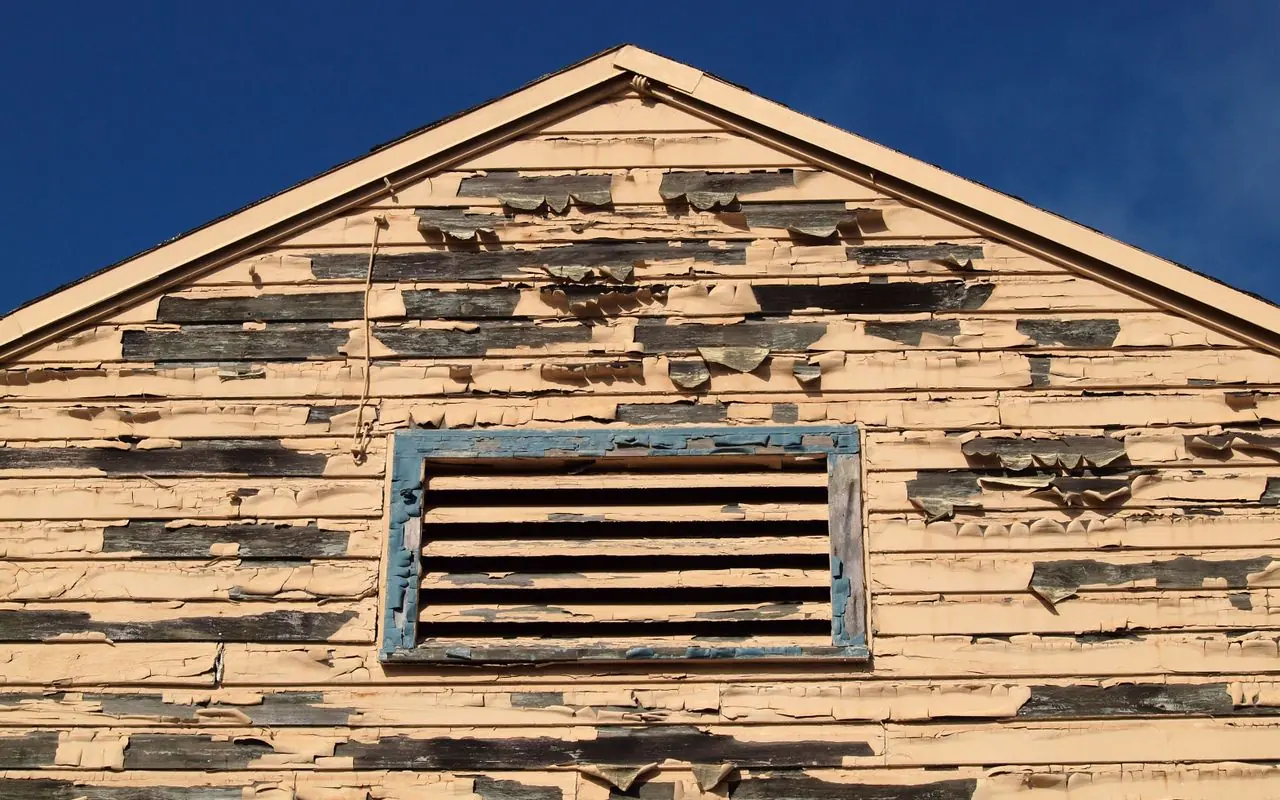
Chalking, flaking, cracking, and peeling paint all require mechanical prep before you can put a brush near them. Chalked surfaces need washing and full sanding. Flaking areas need scraping back to a sound edge, then priming. On an older home that hasn't been painted in 8–12 years, you can expect to find all three. That's not Standard — that's Heavy at minimum, often Very Heavy on weatherboards or rendered surfaces that have moved and cracked.
Previous Coatings and Compatibility
If you don't know what's under the existing topcoat, you're guessing. Oil over water, multiple coats of cheap acrylic, or old lead-based paint all change your approach. Unknown or incompatible previous coatings often mean a full sand and spot-prime at minimum. Lead paint means additional compliance steps in most markets — all of which add real, unbillable-if-not-quoted time.
Weather Exposure and Substrate Damage
North-facing and west-facing elevations cop more UV and heat than south-facing ones. Timber exposed to heavy rain cycles will have raised grain, potential rot pockets, and possible mould. Masonry that's absorbed moisture may be efflorescent or friable. Each of these conditions adds prep steps that simply do not exist on a sheltered or south-facing wall. A blanket prep level across all elevations is always going to miss something.
Access Constraints
Access doesn't change the prep level itself, but it changes how long prep takes. A ladder is slower than a scaffold platform, and a scaffold platform is slower than an elevated work platform (EWP/boom lift/cherry picker). If your crew is repositioning a ladder every 10 minutes to work around a roofline or gutter, your effective prep rate drops. Factor access into your area downtime — and if it's genuinely complex multi-level access, the default 10% area downtime may need revisiting.
The Real Cost of Getting Prep Wrong
Let's run the full numbers on a realistic mid-size exterior repaint — 350 m² (3,770 ft²) of total paintable surface across walls, fascia, and trim.
Application hours using production rate defaults:
- Walls at Step 4 (15 m²/hr / 160 ft²/hr): 280 m² ÷ 15 = 18.7 hrs
- Fascia/gutters at Step 4 (15 m²/hr / 160 ft²/hr): 40 m² ÷ 15 = 2.7 hrs
- Skirting/trims at Step 3 (10 m²/hr / 110 ft²/hr): 30 m² ÷ 10 = 3.0 hrs
- Total application: 24.4 hours
Now apply prep:
- Standard at 25 m²/hr: 14.6 hours
- Heavy at 9.25 m²/hr: 39.5 hours
- Very Heavy at 6 m²/hr: 60.8 hours
The difference between quoting Standard and quoting Heavy is 24.9 hours. At $50/hr AUD fully-loaded labour cost, that's about $1,245 AUD in unrecovered labour cost — per job, not per week. Run 15 exterior repaints in a month and you've absorbed roughly $18,700 in labour costs that were never in the quote. At $35/hr USD, that's about $870 USD per job, or over $13,000 across a month of work.
This is not a rounding error. This is where real margin disappears.
How to Set the Right Prep Level Before You Quote
The fix isn't complicated, but it does require discipline at the quoting stage. Before you assign a prep level on any exterior repaint, ask yourself four questions on site:
- Is there any visible coating failure — flaking, cracking, chalking, or peeling?
- Do I know what's under the existing topcoat, and is it compatible?
- Has this surface had significant weather exposure — UV, moisture, or thermal movement?
- Are there areas where access will slow the prep process down?
If the answer to any of these is yes, Standard prep is almost certainly wrong. One yes gets you to Moderate (15 m²/hr). Two or more gets you to Heavy (9.25 m²/hr). Visible substrate damage or unknown multiple coatings gets you to Very Heavy (6 m²/hr).
When you're building the quote, Surfacely's quoting cost tool lets you set prep level independently on each area — so your weathered south wall and your sheltered garage door can carry different prep levels without needing a spreadsheet workaround. The labour cost impact shows up immediately, before the quote goes out.
One Number That Changes Everything
The most common mistake in a prep time painting estimate isn't laziness — it's habit. Contractors who quote Standard prep on everything aren't trying to underprice. They learned a default and never tested it against real job data.
Pull up your last five exterior repaints. Compare what you quoted in prep hours to what you actually spent. If the gap is more than half an hour per job, you've found your margin leak. The prep level system exists precisely because not every surface needs the same treatment — and quoting like it does is a fast way to build a busy business that barely breaks even.
Nail your prep estimates, and your exterior repaint margins will follow.