
Spray vs Brush Painting Cost: The Real Math Behind Which Method Actually Saves You Money
Spray guns cover ground fast. A good operator can push through 30 m² (300 ft²) an hour on production work, versus 15 m² (150 ft²) rolling walls by hand. So it's half the labour hours, half the cost — right? Not even close. Spray uses 20% more paint, demands full masking, and one overspray incident can eat your profit faster than a bad material bill. Before you default to spray on every job, or avoid it out of habit, you need to run the actual numbers.
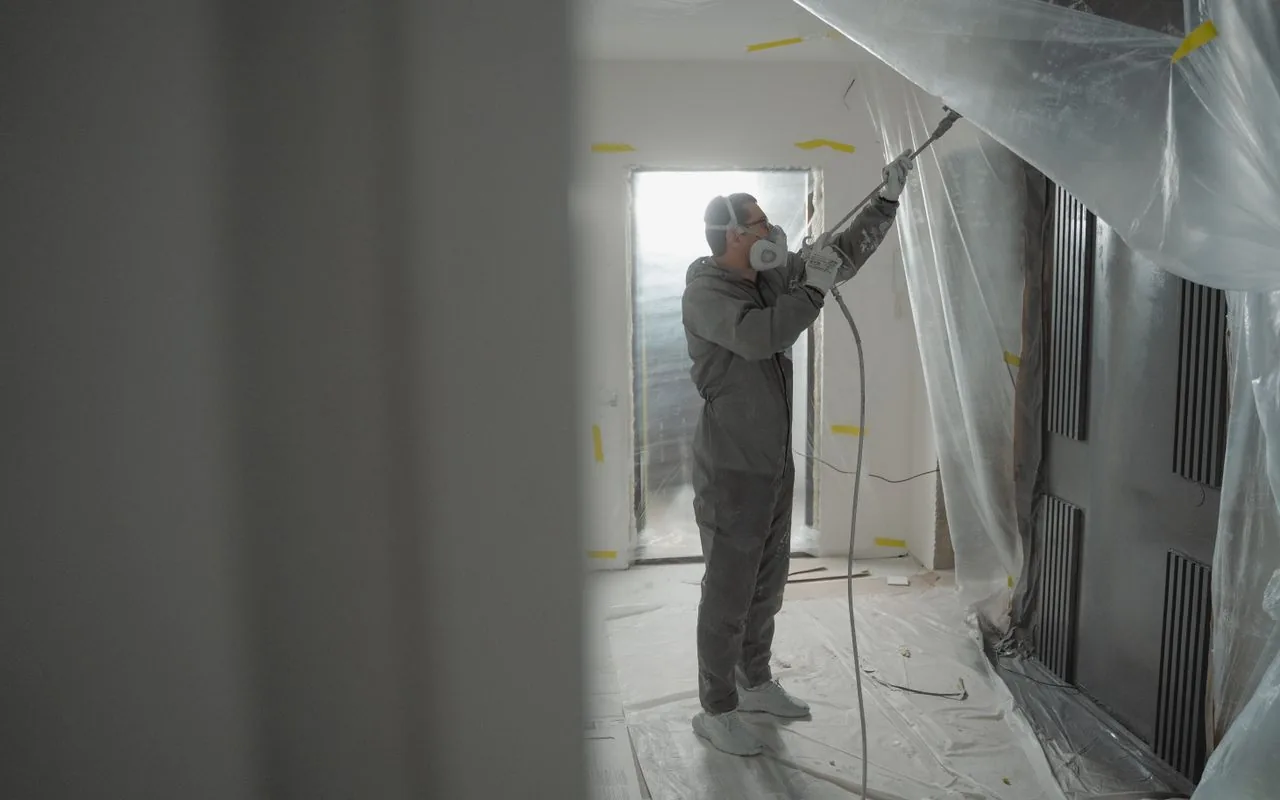
Why Speed Alone Doesn't Determine Method Cost
Most contractors look at production rates and stop there. Spray is faster, so they assume it's cheaper. But your job cost has three moving parts: labour hours, material volume, and setup time. Spray wins on the first, loses on the second, and the third depends entirely on the job.
Here's how Surfacely's production rate system maps out the difference between methods on a standard wall:
- Brush and roll (Step 4 — Steady): 15 m²/hr (160 ft²/hr) — standard repaint, good conditions
- Production spray (Step 7 — Rapid): 30 m²/hr (325 ft²/hr) — repetitive surfaces, open access
- Full new-build spray (Step 8 — Production): 35 m²/hr (375 ft²/hr) — maximum coverage, nothing in the way
Spray roughly doubles your coverage rate. But that speed advantage only holds on open, unobstructed surfaces where masking is minimal. The moment you're working around furniture, joinery, landscaping, or neighbouring properties, your setup time grows — and your per-square-metre advantage shrinks fast.
The Paint Wastage Factor Nobody Quotes Correctly
Spray atomises paint. That's how it achieves such fast, even coverage. But atomisation means overspray — and overspray means waste. The standard rule: spray consumes 20% more paint than brush and roll to cover the same area.
In quoting terms, this means applying a 0.8× multiplier to your spread rate when calculating materials for a spray job. If your default spread rate is 12 m²/L (roughly 489 ft²/gal), spray brings that effective rate down to around 9.6 m²/L (391 ft²/gal).
On a small room — say 60 m² (645 ft²) of wall surface — that difference is maybe half a litre. Manageable. But scale that to a 500 m² (5,380 ft²) exterior repaint and you're adding 10+ litres of paint to your material bill. At premium paint prices, that's $80–$200 depending on your market, before you've accounted for masking materials and prep time.
This is exactly the scenario where contractors quote spray as a cost-saving method, then wonder why their margin disappeared. The labour saving was real. The material blowout was just as real — and they didn't account for it.
When Spray Actually Wins on Cost
Spray makes financial sense when two conditions are met: the surface area is large enough that labour savings outweigh material waste, and masking time is low relative to the area being painted.
The clearest wins for spray are:
- New builds with no furniture or fixtures: No masking, no interruptions. Step 8 production rates are achievable. Labour savings are significant and nothing needs protecting.
- Large exterior cladding or fence runs: Open access, repetitive surface, minimal detail. A 200 m² (2,150 ft²) fence run at Step 7 spray takes roughly 6.5 hours. The same run brush and roll at Step 4 takes 13+ hours. Even with a 20% paint premium, the labour saving wins by a wide margin.
- Repetitive commercial interiors: Warehouse walls, stairwells, car parks. Consistent surface, controlled environment, minimal masking. Spray is the right call every time.
As a rough guide: if your spray masking and setup time exceeds 20–25% of your total estimated spray hours, run the numbers again. The break-even point shifts closer than most contractors expect.
When Brush and Roll Wins — Or at Least Ties
Occupied homes are where spray loses its edge quickest. Every surface that can't get paint on it needs masking. Furniture either moves out — adding time — or gets sheeted — adding time and material. Soft furnishings, timber floors, glass, and kitchen cabinetry all need protection. That setup eats into your production rate advantage before you've picked up the gun.
Consider a standard three-bedroom repaint: 180 m² (1,940 ft²) of walls, fully furnished, typical suburban home. Spray would theoretically take 6 hours at Step 7. But add 2–3 hours of masking and furniture shuffling, and your total is 8–9 hours. Brush and roll at Step 4 takes 12 hours — but with near-zero setup cost and no overspray risk.
The gap narrows significantly. And when you factor in the paint wastage on those 180 m², spray starts to look like the more expensive option on labour and materials — not just one.
Other situations where brush and roll is clearly the better choice:
- Feature walls with heavy colour changes and tight cut-in lines
- Exterior work in windy conditions where overspray drifts onto neighbouring property
- Jobs with detailed trims, mouldings, or heritage features requiring Step 1–2 precision
- Any site where the client hasn't vacated and ventilation is limited
How to Quote Each Method Without Losing Margin
The fix isn't to pick a method and stick to it. It's to quote both methods accurately and choose based on the numbers, not habit or assumption.
For spray quotes, make sure you're doing three things every time:
- Apply the 0.8× coverage multiplier to your spread rate. Don't quote materials as if spray covers the same as brush and roll.
- Add masking and setup as a separate labour line. It's real time and it needs to be in your quote. A good starting point is estimating masking at one hour per 50–60 m² (540–645 ft²) of adjacent surface — more in occupied or complex spaces.
- Choose the right production rate step for the actual conditions. Step 7 (30 m²/hr / 325 ft²/hr) applies to open, repetitive work. If the surface isn't open, step it down. Quoting Step 8 on a job that's really a Step 6 is where spray quotes fall apart.
For brush and roll, the most common error is using Standard prep (25 m²/hr) on a surface that needs Heavy prep (9.25 m²/hr) or Very Heavy (6 m²/hr). That gap — 25 m²/hr versus 9.25 m²/hr — is one of the biggest sources of margin erosion in exterior repaints. The paint condition was obvious on-site. It just didn't make it into the quote.
Surfacely lets you switch between spray and brush application at the area level, automatically adjusting production rates and material calculations — including the 20% spray wastage factor. It doesn't make the decision for you, but it makes the cost difference visible before you commit to a price.
The Takeaway
Spray is a tool, not a default. It saves real money on the right jobs and costs real money on the wrong ones. The difference comes down to surface area, masking complexity, paint volume, and whether your production rate assumption actually matches the site conditions.
Run the numbers on both methods before you quote. It takes five minutes and it will stop you winning jobs at a loss because the spray saving looked bigger on paper than it was on the day.
If you want to see how your current quotes stack up on spray versus brush, Surfacely's quoting tools make it easy to model both methods side by side on the same job.