
Safe Work Plans for Painting Contractors: JHA, RAMS, SWMS, SSSP
Painting contractors need a written safe work plan for any job that involves significant construction-site hazards — and almost every commercial painting job qualifies, plus most exterior residential work above ground floor. The document is called a JHA in the United States, RAMS in the United Kingdom and Ireland, SWMS in Australia, SSSP in New Zealand, and a site-specific safety plan or JHA in Canada under provincial OHS Acts. EU member states call it a Risk Assessment under the Framework Directive. The structure is the same in every jurisdiction — hazards, controls, residual risk, sign-off. Only the regulatory framework cited and the document name change.
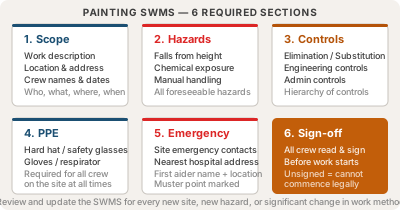
Document type by country
Surfacely's crew brief flags the hazards and structures the safe-work-plan section using the right document name and regulatory framework for the painter's country. The values below are the ones it uses by country.
| Country | Document name | Abbreviation | Regulatory framework | Regulatory body |
|---|---|---|---|---|
| United States | Job Hazard Analysis | JHA | OSHA 29 CFR 1926 | OSHA |
| United Kingdom | Risk Assessment & Method Statement | RAMS | Health and Safety at Work Act 1974 | HSE |
| Australia | Safe Work Method Statement | SWMS | Work Health and Safety Act 2011 | Safe Work Australia |
| New Zealand | Site-Specific Safety Plan | SSSP | Health and Safety at Work Act 2015 | WorkSafe NZ |
| Canada | Site-specific safety plan / JHA | varies | Provincial OHS Acts (AB, BC, ON, QC etc.) | Provincial WHS body |
The 12 painting hazards Surfacely tracks
Surfacely automatically flags hazards from the job details — building age, storey count, application method, access equipment booked, defect notes, occupancy. The 12 painting-specific hazard categories below are checked on every crew brief.
| Hazard | Trigger | Typical controls |
|---|---|---|
| Working at height | Building has 2+ storeys, OR any external area | Fall prevention plan, edge protection, harness if >2 m unprotected, daily equipment inspection |
| Spray inhalation | Any surface being sprayed | P2 respirator minimum, ventilation, overspray containment, exclusion zone signage, MSDS on site |
| Enclosed-space spray | Spray in an internal area | Forced ventilation, 15 min break per hour, buddy system, vapour monitoring if >2 hr continuous |
| Spray + occupant exposure | Spray in an occupied building | Seal occupied areas, 24 hr notice, schedule low-occupancy windows |
| Lead paint | Building year before locale cutoff (1970 AU/NZ, 1978 US, 1992 UK/EU) | Lead test before disturbance, wet methods, P2 respirator, contained waste disposal, decontamination |
| Asbestos | Building year before locale cutoff (2003 AU, 1999 UK, 2016 NZ) | Asbestos register check, do not disturb, stop and report if found, licensed assessor |
| Heritage fabric | Building flagged heritage | Approved methods only, no mechanical prep without approval, photographic record |
| Occupant interaction / trip hazards | Occupied building | Barrier tape, dust sheets on walkways, tools stored EOD, wet-paint signage, daily occupant comms |
| Scaffold collapse / fall | Quote includes scaffold access | Licensed scaffolder, tag system, daily pre-use inspection, no painter alterations, exclusion zone at base |
| EWP tip-over / fall | Quote includes scissor or boom lift | Licensed operator, daily pre-start, firm level ground, outriggers, spotter near obstacles |
| Fall from ladder | Quote includes ladder access | Industrial-rated ladder, 3-point contact, 4:1 angle, secured at top, max 30 min continuous use |
| Biological hazard | Surfaces flagged with mould or biological defect | Biocide treatment, P2 respirator, gloves and eye protection, dwell time observed |
Beyond those 12 automatic hazards, the painter's site assessment can manually add electrical, water-damage, structural concern, traffic / road proximity, overhead hazards, and confined-space entries. Each one becomes its own hazard-and-control entry on the safe work plan.
The 5×5 risk matrix
Each hazard is scored on Likelihood (1–5) and Consequence (1–5). The product is the Risk Score (1–25). The matrix is the standard tool for prioritising controls — the highest-scoring hazards are addressed first, and no work commences until residual risk is at Medium or below.
| Insignificant (1) | Minor (2) | Moderate (3) | Major (4) | Catastrophic (5) | |
|---|---|---|---|---|---|
| Almost certain (5) | 5 | 10 | 15 | 20 | 25 |
| Likely (4) | 4 | 8 | 12 | 16 | 20 |
| Possible (3) | 3 | 6 | 9 | 12 | 15 |
| Unlikely (2) | 2 | 4 | 6 | 8 | 10 |
| Rare (1) | 1 | 2 | 3 | 4 | 5 |
Score bands: 1–4 Low (green) 5–9 Medium (yellow) 10–14 High (orange) 15–25 Extreme (red)
JHA for painting contractors (United States)
The OSHA 29 CFR 1926 Subpart C and Subpart L requirements for painting JHAs:
- Job description and step-by-step task breakdown
- Hazards for each step — particularly fall protection above 6 ft (Subpart M / 1926.501)
- Required PPE — respirators per 1926.103, eye protection per 1926.102
- Control measures — engineering, administrative, PPE
- Lead paint controls per 1926.62 if applicable
- Scaffold use per Subpart L (1926.450–454)
- Electrical clearance per 1926.416
- Hazard Communication / SDS availability per 1910.1200
- Worker training and acknowledgment
RAMS for painting contractors (United Kingdom & Ireland)
The HSE (UK) and HSA (Ireland) expect a RAMS to cover both Risk Assessment (the hazards and scoring) and Method Statement (the step-by-step how-to). For painting:
- Site address, painter's company details, CDM duty holder if construction project >500 person-days or >30 working days with more than 20 workers on site simultaneously
- Risk assessment per Management of Health and Safety at Work Regulations 1999 (UK) or General Application Regulations 2007 (IE)
- Work at Height Regulations 2005 controls — fall prevention before fall arrest
- Scaffold per NASC TG20 or design specification
- Electrical per BS 7671 and HSG85
- Lead — Control of Lead at Work Regulations 2002 if pre-1992 building
- Asbestos — Control of Asbestos Regulations 2012 (UK) if pre-1999 building
- COSHH assessment for paint products and solvents
- Method statement step-by-step with control points and review triggers
SWMS for painting contractors (Australia)
The SWMS document content required by Safe Work Australia, applied to painting work:
- Project address, principal contractor (PC) name, painter business name and ABN
- Person responsible for SWMS implementation (the painter's site supervisor)
- Description of the high-risk construction work being performed
- The specific high-risk construction work categories under WHS Reg 291 that apply (typically 291(a) fall >2 m, 291(f) atmospheric, 291(b) electrical, 291(c) asbestos)
- Hazards identified for each task, with risk scores
- Control measures, assessed in hierarchy of control order: eliminate → substitute → engineer → admin → PPE
- Residual risk score after controls applied
- Worker consultation evidence — sign-off from the workers performing the task
- Review trigger — when the SWMS will be reviewed (incident, scope change, control failure)
SSSP for painting contractors (New Zealand)
WorkSafe NZ expects a Site-Specific Safety Plan that adapts the painter's overall H&S system to the particular site. For painting:
- Site address, principal (PCBU) details, painter business and key contacts
- Notifiable work declaration if any task crosses the threshold (work above 5 m, scaffold over 5 m, restricted asbestos work, etc.)
- Risk identification and controls per the Health and Safety at Work Act 2015 and the General Risk and Workplace Management Regulations 2016
- Working at height per the Best Practice Guidelines for Working at Height in NZ
- Scaffold per NZS 3610
- Electrical per NZECP 34 — clearances from overhead lines
- Asbestos per the Health and Safety at Work (Asbestos) Regulations 2016 if pre-2016 building
- Hazardous Substances Regulations 2017 inventory for paint products and solvents
- Toolbox talk / sign-on register evidence and review triggers
Site-specific safety plan (Canada)
Canadian occupational health and safety law is provincial. The structure and content of a painting safety plan are similar across provinces but cite different acts:
- Site address, prime contractor and constructor details, painter business and WSIB / WCB / WSBC / CNESST account number
- Hazard assessment per the relevant provincial OHS Act and regulations (Ontario OHSA, BC OHS Regulation, Alberta OHS Code, Quebec LSST, etc.)
- Fall protection above 3 m (most provinces) or 1.8 m (Ontario residential), with written rescue plan
- Scaffold per CSA Z797 or provincial equivalent
- Lead paint per provincial designated-substance regulations if pre-1976 building (varies)
- Asbestos per provincial designated-substance regulations — Ontario Reg. 278/05, BC OHSR Part 6, etc.
- WHMIS 2015 SDS sheets for paint products and solvents
- Worker orientation and acknowledgment, signed by every crew member entering the site
Risk Assessment (EU member states) — for reference
For context outside Surfacely's supported countries: the EU Framework Directive 89/391/EEC requires a written risk assessment for any workplace with significant hazards. National implementations differ in document name and format, but the core content is consistent — hazard identification, control measures, residual risk, and worker consultation. Surfacely's crew brief is built for AU, US, GB, NZ and CA, so it does not produce an EU-specific output.
When a safe work plan is required
Every country Surfacely supports has its own trigger thresholds. The painting work that most often crosses them — falls above an unprotected edge, spray application, lead, asbestos, electrical proximity, and confined spaces — is essentially the same everywhere. The legal floor is summarised below; best practice is to produce a safe work plan for every job regardless of trigger.
| Country | Trigger | Most common painting touchpoints |
|---|---|---|
| United States | OSHA 29 CFR 1926 expects a documented hazard analysis on construction work; written JHA mandatory for lead (1926.62), asbestos (1926.1101), and confined-space entry (1926.1203) | Fall protection above 6 ft, spray respirator selection, lead disturbance, scaffold pre-use inspection |
| United Kingdom | Significant hazards under MHSWR 1999; CDM 2015 duty holder requirements on projects >500 person-days or >30 days with >20 simultaneous workers | Work at Height Reg 2005 above any unprotected edge, COSHH for solvents, asbestos pre-1999 buildings, lead pre-1992 |
| Australia | Any of the 18 high-risk construction work categories under WHS Reg 291 — most commonly r291(a) fall >2 m, r291(b) electrical, r291(c) asbestos, r291(f) atmospheric, r291(k) traffic, r291(q) confined space, r291(r) hazardous materials | Almost any external repaint above ground floor, all spray work, near overhead lines, pre-2003 fibre cement |
| New Zealand | Notifiable work under HSWA 2015 — work above 5 m, scaffold over 5 m, restricted asbestos work, hot work in hazardous areas | Multi-storey exterior repaints, restricted asbestos work pre-2016 buildings, lead pre-1970 |
| Canada | Provincial OHS Acts each require written hazard assessment for fall risks, designated substances, and confined-space entry — Ontario Reg. 213/91, BC OHSR Part 11, Alberta OHS Code Part 9, Quebec CSTC | Fall protection above 3 m (1.8 m Ontario residential), asbestos in pre-1990 buildings, lead in pre-1976 |
Lead paint — when additional controls are required
Residential lead paint was phased out at different points in different countries. Surfacely flags a building automatically when the year it was built falls before the locale cutoff and adds a lead-paint hazard with the relevant controls: lead test before disturbance, wet preparation methods, half-face P2 / P100 respirator minimum, contained waste disposal, painter decontamination on exit, and notification to the principal contractor or constructor.
| Country | Lead paint cutoff (build year before…) | Governing instrument |
|---|---|---|
| United States | 1978 | OSHA 1926.62 + EPA RRP Rule (40 CFR 745) |
| United Kingdom | 1992 | Control of Lead at Work Regulations 2002 |
| EU member states | 1992 | Directive 98/24/EC + national chemical agents regs |
| Australia | 1970 | Safe Work Australia Lead Code of Practice |
| New Zealand | 1970 | WorkSafe NZ Health and Exposure Monitoring Guide |
| Canada | 1976 (varies by province) | Provincial designated-substance regs (e.g. Ontario Reg. 490/09) |
Spray painting — additional safe work plan content
Spray application creates atmospheric contamination by definition and triggers extra controls in every jurisdiction — OSHA 1926.103 (US), COSHH (UK), WHS Reg 291(f) (AU), HSWA 2015 (NZ), provincial OHS regs (CA), and Directive 98/24/EC (EU). Surfacely automatically adds three spray-specific hazards whenever any surface on the job is being sprayed:
- Spray inhalation — controls: half-face P2 / P100 respirator minimum, adequate ventilation, overspray containment, exclusion zone signage, SDS on site.
- Enclosed-space spray (added when the spray surface is internal) — controls: forced ventilation, 15 min break per hour, buddy system, vapour monitoring if >2 hr continuous.
- Occupant exposure (added when the building is occupied during works) — controls: seal occupied areas, 24 hr notice to occupants, schedule during low-occupancy periods.
Related guides
FAQ
What safe work plan do painting contractors need?
Depends on the country. JHA in the US (OSHA 29 CFR 1926), RAMS in the UK (HSWA 1974), SWMS in Australia (WHS Act 2011), SSSP in New Zealand (HSWA 2015), site-specific safety plan or JHA in Canada (provincial OHS Acts). (For reference, Ireland uses RAMS and EU member states use a Risk Assessment under the Framework Directive — outside Surfacely's supported countries.) Same structure, different regulatory citation. Surfacely builds your crew brief with the hazards flagged for your country's format (AU, US, GB, NZ, CA) for you to review and complete.
What is the difference between a SWMS, a JHA, a RAMS, and an SSSP?
The same kind of document under different national safety laws. Hazards, controls, residual risk, and worker sign-off are common to all four; the regulatory framework cited and the document name change.
What hazards must a painting safe work plan include?
Working at height, spray inhalation, electrical proximity, lead paint (cutoffs vary by country), asbestos, scaffold/EWP/ladder fall risks, biological growth, confined space, traffic, occupant interaction. Whatever applies to the specific job.
When is a painting safe work plan legally required?
US: any construction work, written JHA mandatory for lead, asbestos, confined-space. UK: any work with significant hazards under MHSWR 1999. AU: any of the 18 high-risk construction work categories under WHS Reg 291. NZ: notifiable work under HSWA 2015. CA: per provincial OHS Act. Best practice everywhere is one per job.
What is a 5x5 risk matrix in a safe work plan?
Likelihood (1–5) × Consequence (1–5) = Risk Score (1–25). 1–4 Low, 5–9 Medium, 10–14 High, 15–25 Extreme. Controls must reduce score to Medium or below before work can start.
How do crew sign off on a safe work plan?
QR code on the crew brief opens a sign-off portal. Crew tick read, sign with finger or stylus, signature plus name plus timestamp captured on the project record.
Does spray painting need extra safe work plan content?
Yes — spray triggers atmospheric contamination, enclosed-space spray, and occupant-exposure hazards that get added to the existing safe work plan. Not a separate document.
Does Surfacely's crew brief support country-specific safe-work-plan formats?
Yes. The safe-work-plan section labels, regulatory framework, regulatory body, and emergency number all switch based on the painter's country (AU, US, GB, NZ, CA). Those country settings get locked onto each crew brief when it's generated, so old documents always read the way they did at the time. It is not a substitute for a regulator-ready document you review and complete.