
How to Quote Exterior Painting: Surfaces, Access, and Material Allowances
Three things separate an exterior quote from an interior quote: pressure wash, access equipment, and weather allowance. Skip them and the painter eats the gap.
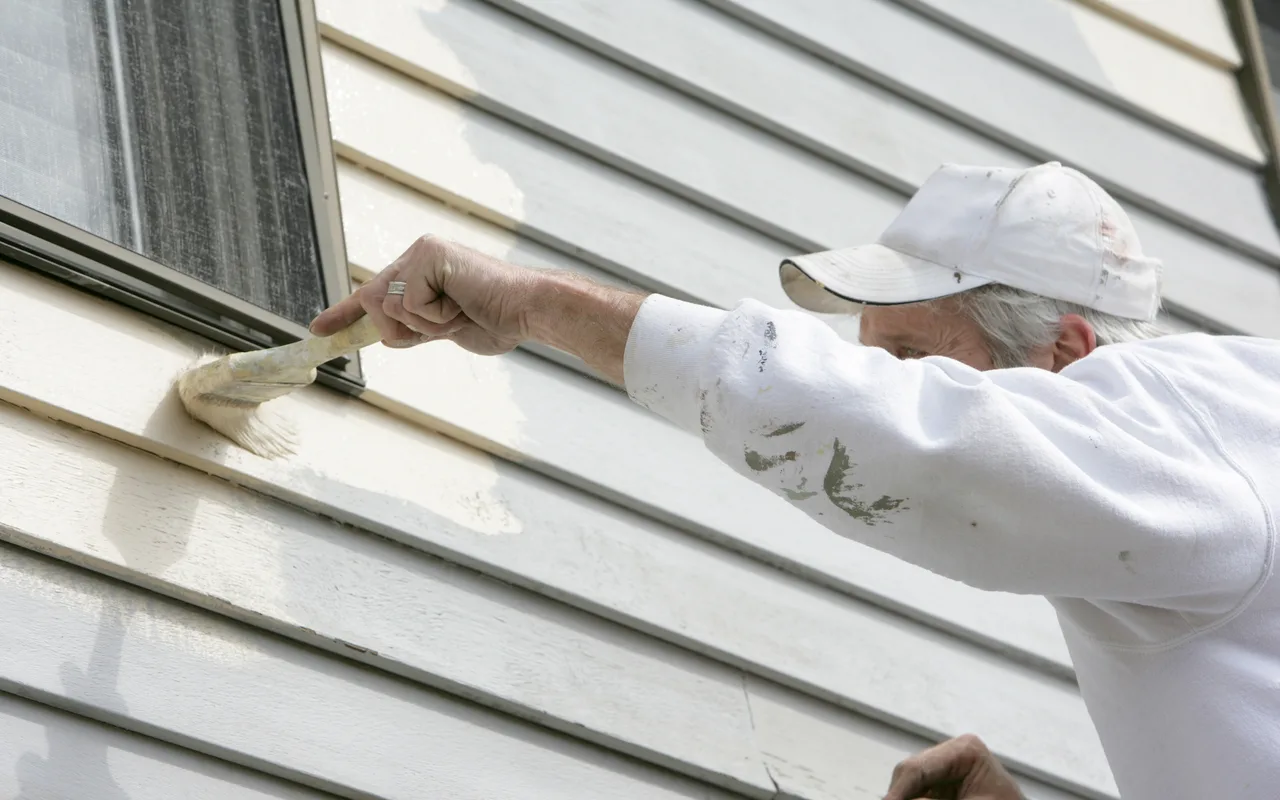
Exterior painting quotes need three things interior quotes don't: pressure wash time, access equipment, and a higher prep allowance for sun damage and biological growth.
Pressure wash — the auto-generated prelim
Surfacely auto-generates a wash & preparation line on every repaint with external area. The calculation:
washHours      = totalExternalArea ÷ washRate
washRate (US)  = 800 ft²/hr (default)
washRate (SI)  = 75 m²/hr (default)
For 2,150 ft² (200 m²) of exterior, that's 2,150 ÷ 800 ≈ 2.69 hours of wash (or 200 ÷ 75 ≈ 2.67 hours from the metric defaults). New build projects skip this — bare substrate doesn't need washing.
Surfacely stores all rates in metric and converts to imperial only at the display layer, so US painters see ft²/hr without any precision drift.
Access equipment as a separate cost line
Scaffold, scissor lift, boom lift — these go in the access section, not labour. Surfacely seeds three locale-aware templates:
- Scaffold: delivery + erect & dismantle + weekly hire (week-locked)
- Scissor lift: delivery + collection + day or week hire
- Boom lift: delivery + collection + day or week hire
Default margin on access equipment is 15% — the painter's value is logistics, not value-add. Cost-plus applies to all three.
Common exterior surface formulas
| Surface | Formula | Default coats | Speed step |
|---|---|---|---|
| Fascia | length × board width | 2 | 3 — Careful (110 ft²/hr · 10 m²/hr) |
| Soffit | length × overhang depth | 2 | 3 — Careful (110 ft²/hr · 10 m²/hr) |
| Gutter | length × profile girth | 2 | 3 — Careful (110 ft²/hr · 10 m²/hr) |
| Roof | plan area × pitch factor (1.0 – 1.5) | 2 | 5 — Efficient (215 ft²/hr · 20 m²/hr) |
| Barge board | length along slope × board width | 2 | 3 — Careful (110 ft²/hr · 10 m²/hr) |
| Downpipes | pipe girth × length × qty | 2 | 3 — Careful (110 ft²/hr · 10 m²/hr) |
| Timber deck | length × width × qty | 2 | 3 — Careful (110 ft²/hr · 10 m²/hr) |
| Brickwork | length × height × qty | 2 | 3 — Careful (110 ft²/hr · 10 m²/hr) |
| Metal cladding | length × height × qty | 2 | 4 — Steady (160 ft²/hr · 15 m²/hr) |
Material allowances on exterior
Spread rates drop on rough exterior substrates. Apply Surfacely's coverage adjustment — the multiplier applies to whichever spread rate the painter has set (ft²/gal in the US, m²/L in metric markets):
- Soaks it up: ×0.70 (30% less coverage) — porous, rough, unpainted masonry
- Normal: ×1.00 — standard exterior repaint in good condition
- Covers well: ×1.15 — sealed, smooth, previously well painted
Weather and rework allowance
Build a contingency line into overheads for weather delays. Most painters use 5–10% of total job hours.
Prep is the exterior number that decides the job
Everything above is the easy part. Prep is where exterior repaints are won and lost, and it is the line most quotes get wrong by a mile.
Prep has its own production rate, in the same units as your painting rates — a slower rate means more prep. On a sound interior repaint, Standard at 25 m²/hr is about right. An exterior that has had eight to twelve years of sun and rain is not a Standard job:
- Standard (25 m²/hr) — sound, recently maintained, washes up clean
- Moderate (15 m²/hr) — older surface, more filler, some scraping
- Heavy (9.25 m²/hr) — neglected or peeling: spot strip, extensive filling, primer spots
- Very Heavy (6 m²/hr) — weathered timber, full strip, substrate repair
Work the gap. On 350 m² (3,770 ft²) of weatherboard at two coats and Step 4, you are looking at roughly 47 paint hours. Standard prep adds 14 hours. Heavy adds 37. That is 23 hours of difference on one decision — at $50/hr AUD or $35/hr USD, somewhere between $800 and $1,150 that either sits in your quote or comes out of your pocket.
Walk the worst elevation, not the one facing the street. North and west faces cop the UV. If you find flaking, chalking or bare timber anywhere, you are not quoting Standard.
What triggers access equipment
Access is the other line that gets assumed rather than quoted. The trigger is not the height of the building — it is whether your crew can work safely and at a normal pace from a ladder.
- Single storey, clear ground — ladders and trestles, no hire line needed.
- Two storey, or a gable above a roofline — scaffold or an EWP. A ladder here does not just risk someone, it halves the production rate because the crew reposition constantly.
- Sloping ground, retaining walls, or a pool between you and the wall — scaffold, and price the extra erect time.
- Anything over a public footpath — check whether you need a permit before you quote, not after you win.
Real numbers: an EWP runs about $350–600 USD a day, scaffold on a standard two-storey house $1,500–3,000 USD. If that is not a line item, it is your margin.
Weather is a schedule cost, not just a price one
Dew point matters more than rain. A surface below dew point will not take a coat properly no matter how blue the sky is, which is why autumn and spring exteriors lose mornings rather than whole days.
The honest way to handle it is float in the program rather than padding in the price. Tell the client up front what a wet week does to the finish date, and put it in writing — otherwise a weather delay reads to them as your crew being slow, and that conversation costs more than the days did.