
AI for Painting Contractors: What's Useful and What to Ignore (2026)
Three AI applications are genuinely useful in painting businesses today: photo analysis for surface and defect identification, voice transcription for field notes during assessments, and the homeowner self-scope portal that lets a client submit photos and rooms before a site visit. Everything else AI vendors are selling to the painting trade is either not useful or actively risky. The painter's judgement is still the most expensive thing in the system, and AI's job is to make that judgement faster — not replace it.
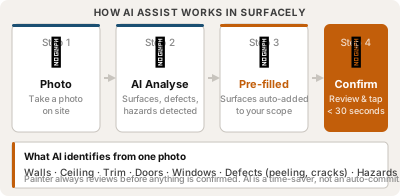
1. AI photo analysis for surface assessment
The painter takes a photo of a wall, ceiling, or external elevation during the site visit. Surfacely's vision model identifies the surfaces in the photo, flags likely defects (cracks, peeling, mould, rust, water damage), and suggests a prep level. The painter reviews and confirms — the AI never auto-applies anything to the quote. The painter is always the final decision.
What it's good at: distinguishing wall from ceiling, identifying gutter from fascia in a complex elevation, flagging visible mould or peeling. What it's not good at: measuring dimensions from a photo, detecting hidden defects under existing paint, or deciding when prep is "moderate" vs "heavy" — the painter still owns those calls.
2. Voice transcription for field notes
The painter walks a building speaking notes — "front elevation, fibre cement weatherboard, two-storey, scaffold required, mould on south wall, gutters in good condition." Surfacely transcribes the audio and parses it into structured assessment data: area name, building type, surface conditions, hazards. The painter reviews and confirms.
This works because painters already think out loud during assessments. Capturing the speech and parsing it saves the typing — which is where assessment data gets dropped under time pressure. Voice-first scoping is significantly faster than tap-first scoping on a phone.
3. Homeowner self-scope — AI-assisted lead intake
This is the one that's structurally novel. A homeowner submits a quote request through the painter's website or a direct link. The self-scope portal walks them through their property — rooms, surfaces, condition photos, colour preferences. AI assists at each step: suggesting surfaces from photos, surfacing common rooms, prompting for the information that makes the painter's job easier.
The completed self-scope materialises in the painter's account as a draft project with measurements, photos, and condition notes. The painter reviews, refines (often by site visit if the job is large), and quotes — without spending the first 90 minutes of project life driving to and from a measurement appointment.
For low-value or high-volume work (interior repaint of a single room, fence painting, stair handrail), self-scope can deliver an accurate quote without any site visit. For larger jobs, it's a free pre-qualification — the painter knows whether the lead is worth visiting before the trip.
4. AI proposal drafting
Once the quote is built, AI can draft the proposal copy: scope summary, surface descriptions, warranty terms, project narrative. The painter reviews. Surfacely's proposal builder includes AI-suggested copy at each section, with the painter accepting, editing, or replacing.
What this is good for: saving 20–30 minutes of writing per proposal, which adds up across a 200-quote year. What it's not good for: setting the price, choosing the margin, deciding which surfaces to include, overriding the painter's pricing logic.
5. AI help Q&A
Surfacely includes an AI help drawer — ask a question, get a direct answer drawn straight from the platform's own documentation. The painter asks "how do I create a variation?" or "where do I set after-hours rates?" and gets a direct answer with links to the relevant settings. Capped at 20 questions per user per day to keep the cost predictable.
What AI cannot do in painting — honest list
- Measure surfaces accurately from photos alone. Photogrammetry can produce rough estimates from multi-angle photos with calibration markers, but the consumer-grade approach (single phone photo) doesn't get within 10% of measured truth. Don't quote off it.
- Replace the site visit on commercial work. Access constraints, occupancy, security, parking, and site rules are gathered in person. Photos can't tell you the building manager's surly receptionist won't unlock the rear gate.
- Guarantee estimate accuracy without measured input. Every painting quote ultimately depends on accurate area, coats, prep, and product selection. AI can suggest defaults; the painter still has to confirm them.
- Understand site-specific access constraints. Whether the scaffold can be erected against a heritage façade, whether the EWP can reach the back elevation, whether the deposit lift fits in the goods elevator — AI doesn't see these without site presence.
- Make pricing decisions. The painter sets margin per category, per job, per client relationship. AI can suggest a discount; the painter applies it or doesn't.
The Surfacely AI principle: AI is always optional
Every AI feature in Surfacely is optional. The platform has to work without it — if the photo-analysis service is down, scoping carries on. If the painter prefers to scope without photo assist, they can. AI never auto-applies anything to pricing; the painter accepts or rejects every AI suggestion. This is the line that separates AI as a tool from AI as a hidden source of pricing error.
Related guides
FAQ
Can AI replace a site visit for a painting quote?
No — for anything beyond a single-room repaint. AI photo analysis can identify surfaces and likely defects, but it cannot reliably measure dimensions, assess access, or detect hidden substrate issues.
How does AI photo analysis work in painting software?
Painter takes a photo. The AI returns the surfaces it can see, any defects it spots, and a suggested prep level. Painter reviews and confirms — AI never auto-applies.
What is a self-scope portal for painting contractors?
A branded link homeowners use to submit their own quote request — rooms, photos, condition. AI assists. Result lands in the painter's account as a draft project to review and quote.
Can AI write a painting proposal?
Yes — AI drafts scope summary, surface descriptions, and cover copy. Painter reviews. AI never sets price or margin.
Is AI accurate enough to use in painting estimates?
As an assistant, yes. As the primary input, no. Painter is the final decision on every estimate value. Every AI feature is optional by design — the platform works without it.