
For painters building a real business
Small jobs are easy. Scaling needs a system.
You've always carried the numbers in your head, and honestly it worked — a bathroom, a fence for a friend, you knew the price before you'd finished walking the job. But you're quoting bigger now, and more often. And the head-maths is quietly costing you. Not because you're careless. Because you don't have a complete estimating system yet.
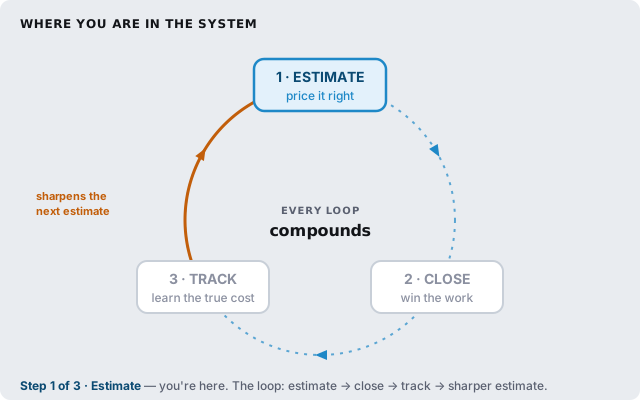
Have you said this to yourself?
Not out loud. Just that quiet voice at the end of a long day.
“I did the quote in my head in their driveway — before I'd even walked the job or known the full scope.”
“They just wanted a rough number, so I gave one. And it stuck.”
“Two jobs almost the same, and somehow I priced them differently. Couldn't tell you why.”
“That one felt like a winner — then it barely paid wages once I'd counted the prep.”
“I can't hand a quote to anyone else. The system is me.”
That last one is the ceiling. If the only place the pricing lives is your head, the business can only ever be as big as you are. You didn't do anything wrong — winging it works for everyone at the start. You've just outgrown it.
What a complete estimating system actually is
Here's the thing a rushed quote misses: a job isn't one number, and a surface isn't one number either. A single wall is a short chain of decisions — and each decision you skip is money leaking out, quietly. A complete system just makes sure you make every decision, on purpose, in the same order, every time.
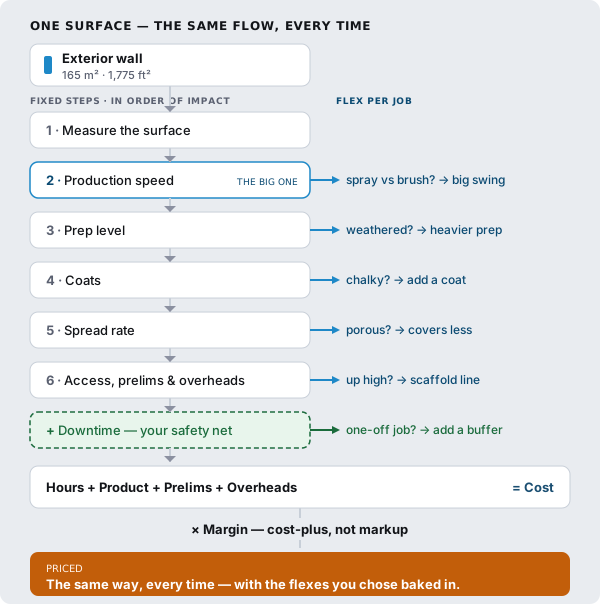
Run every surface through the same layers, and the layers are always these:
- Measure every surface — properly. Not an eyeball, an actual measure. A thorough measure takes 15 to 30 minutes and you do it once. Don't deduct small openings like windows; the cutting-in time around them recovers the area you'd have subtracted.
- Set a production rate per surface. Hours = area × coats ÷ your production rate for that surface and method. Brushing intricate trim is slow. Spraying open new-build walls is fast. The rate is a decision, not a constant.
- Add prep as a real line — not a vibe. Prep is genuinely 30–50% of labour on a normal repaint, and more on weathered exteriors. This is the single biggest thing a head-guess drops.
- Count the coats. One coat, two coats, or a washdown-only changes both the hours and the paint volume. Decide it; don't assume two.
- Materials by spread rate — rounded up. Volume = area × coats ÷ spread rate, rounded up to the next full container. You don't pay for half of one.
- Access, prelims and overheads. Scaffold or lift, set-up and pack-down, protection, and the business costs every job has to carry. All invisible in a driveway number.
- Margin with cost-plus — not markup. Add your margin so the number you target is the number you actually keep. (Markup and margin aren't the same thing, and mixing them up quietly costs you on every job — want to really understand this? →)
Same process, different inputs
Here's the objection every experienced painter has, and it's a fair one: "but every job is different." Exactly. And that's precisely why you need the system.
A system doesn't make every job identical — it makes the process identical. You still change your prep level for a weathered exterior. You still add a coat on a chalky substrate, drop to spray on open walls, add a scaffold line for the high work. The inputs move all the time. What a system does is prompt you to consider each of those variables at the right moment — so flexing them is a deliberate call, never something you forgot on a busy Friday.
Repeatable process, variable inputs. That's the whole game.
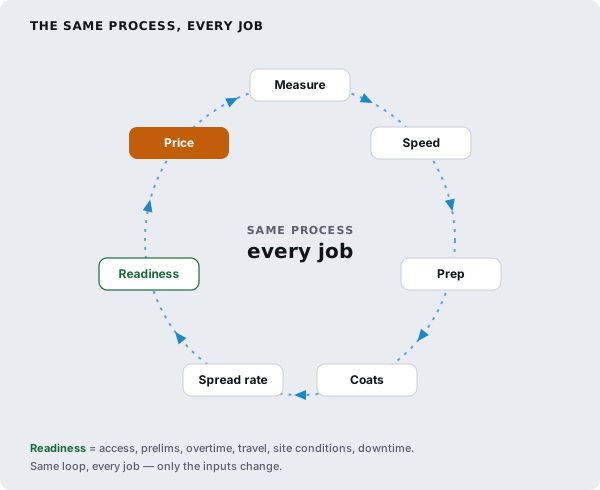
A good system doesn't tell you the obvious
You know to paint the walls. You don't need software for that. What catches you out on a bigger, busier job is never the obvious work — it's the not-so-obvious: the access you'll need for the high sections, the travel to a job across town, the after-hours the client mentioned in passing, the surface that needs a full strip and not just a scuff. Miss one of those and the price is already wrong before you've sent it.
So the system's real job isn't to remind you of what you already know. It's to break a big job into meaningful areas, walk you through the readiness steps — access, overtime, travel, site conditions — and challenge the one or two lines that quietly turn the job from a profit into a loss. That's the difference between a checklist and a system: a checklist repeats what's obvious; a system catches what you'd have missed.
Why the miss gets dangerous as you grow
Here's what nobody warns you about: the percentage you leave on a job barely changes as you scale — but the dollars explode. You learned to price in your head on small jobs, where a miss was invisible, so you never had a reason to fix it. Then the jobs get bigger, and the very same habit takes a bite you can't shrug off.
Say a quote lands 15% under where it should — genuinely easy to do when prep, access, travel and after-hours aren't all counted.
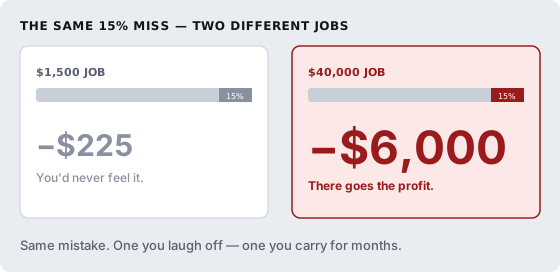
On the $1,500 job that's $225 — a rounding error you'd never notice. On the $40,000 job it's $6,000 — often the entire profit on two weeks' work. Same mistake; one you laugh off, one you carry for months. The bigger you grow, the more a system stops being nice-to-have and becomes the thing protecting your livelihood.
Illustrative. Works in any currency (AU, US, UK, NZ, CA) — the point is the size of the job, not the flag on the money.
Why this is what lets you scale
When the process is repeatable and bulletproof, two things become possible that never were before. You can hand a quote to someone else and trust the number, because the system produces the same price from the same measurements no matter who runs it. And you can quote more, faster, without margin quietly bleeding out of the jobs you win. That's the difference between being a painter who's always busy and building a painting business.
The measure stays thorough — that part is worth doing once, properly. The speed shows up afterwards, in the pricing, the proposal, and the admin.
From the founder
I'm an estimator and a closer. Profit isn't a talent — it's a system, and mine has generated millions in sales every year at an average gross profit of over 40%. Not because I'm good at guessing, but because nothing was left to guess. And I got tired of watching genuinely good painters underprice, over and over, because their system lived in their head where nobody else could run it and the expensive layers kept slipping through.
So I put that system where you can actually use it. You measure the job once, properly, and every layer is carried and priced the same way, every time. You stop leaking profit, you quote with confidence, and — for the first time — you can hand a quote to someone else and trust the number. The measure is thorough. The pricing is instant.
Your first 5 buildings are free. The honest test: run it on your next real quote — one you've already priced in your head — and see the number it gives you. I'll bet it's the layers you'd have missed.
Related guides
- Grow a painting business: the three systems
- How to win more painting jobs
- Painting job tracking: sharpen every quote
- How to quote a painting job: the complete formula
- Painting production rates: complete reference
FAQ
What is a painting estimating system?
A repeatable process for turning a measured job into a price the same way every time — measure every surface, set a production rate and prep level, count coats, calculate materials by spread rate, add access and overheads, then apply margin with the cost-plus formula. The point isn't to make every job identical; it's to make the process identical so nothing gets silently forgotten.
Why do painters underprice jobs?
Usually not carelessness — it's the absence of a system. Pricing in your head works on small jobs, but as jobs get bigger and more frequent the head-maths quietly drops the expensive parts: prep (often 30–50% of labour), the second coat, access, and overheads. The result is a number that feels right and pays wages instead of profit.
How much of a painting job is prep?
Prep is genuinely 30–50% of total labour on a normal repaint, and more on weathered exteriors. A standard repaint preps at about 25 m²/hr (270 ft²/hr); moderate is around 15 (160) and heavy around 9.25 (100) — the slower the rate, the more prep. Leaving prep as a vague allowance is the single biggest reason a rushed quote comes in low.
If every job is different, why do I need a fixed process?
Because a system doesn't make every job the same — it makes the process the same. You still change prep level, coats or production speed for the job in front of you. A system just prompts you to consider those variables at the right moment, so flexing them is a deliberate decision instead of something you forgot. Repeatable process, variable inputs.
Should I just add a buffer to every quote?
No — padding every job makes you uncompetitive and you'll lose work you should win. The smarter move is a deliberate downtime buffer only on genuinely uncertain jobs — an odd building, an unknown substrate, a client you can't read yet — so a surprise eats the buffer instead of your margin. On a job you understand well, trust the system's number.
Isn't estimating software just telling me what I already know?
No — the obvious work isn't where jobs go wrong. A good system is there to catch the not-so-obvious: the access, travel, after-hours and site conditions that are easy to miss on a bigger job, and to challenge the one or two lines that quietly turn a profit into a loss. It breaks the job into meaningful areas and walks you through the readiness steps so nothing that moves the margin gets skipped.
What is the difference between markup and margin?
Markup is added to cost; margin is taken from the sell price. Charging cost times 1.30 is a 30% markup but only a 23.1% margin. To actually earn 30% you divide cost by 0.70. Painters who quote "cost plus 30%" typically earn about 23%, and the gap widens at higher targets.
How do I stop my estimating being all in my head?
Write the process down as fixed steps and run every job through all of them — even the small ones — until it's muscle memory, or use estimating software that holds the steps for you. The real test of a system is whether someone else on your team could produce the same quote from the same measurements. If only you can, the system is you, and that caps how big the business can get.